Friday, January 13, 2006

A Sort Of Life

Exactly five years ago, on this day, on a foggy night, I boarded the Tamil Nadu Express in Delhi, clueless about what lay ahead of me. All I knew was my destination: Chennai. I did not know a soul there and the only address I had was that of my new office.

In the train I tried visualing my life in the city. Food was the easiest to visualise: images of idlis sprang up instantly. I tried visualing my would-be colleagues. Nothing concrete came to my mind: they ended up looking like the people who were travelling with me. When I thought about a house, I could only imagine a window opening to a coconut tree. When I visualised about sex, I could see Silk Smitha biting her lips and beckoning me.

Today, it is five years in Chennai. Five years in the office. Five years in this house. Lucky me. Five years is a long time for luck to sustain itself in one go, and time is approaching when luck will tell me: "Now you take over. I'll come back later." Sure Lady Luck, I will take care of myself when you go, but do come back soon. I cannot wait to have you back in my arms.

I cannot decide whose embrace has been more delightful: Chennai's or Lady Luck's. But in these five years, both have given me enough material to write my own version of Henry Miller's 'rosy crucifixion' trilogy, Sexus, Nexus and Plexus. 'Rosy crucifixion' was the death, at age 33, of one Henry Miller and the ressurection of another.

I can identify with him in the sense that the man who took the train five years ago died the moment it arrived in Chennai. All his friends died too: they are today mere 10-digit numbers in the mobile phone directory. The man who walked out of the station was a stranger to the world -- homeless, friendless -- and waiting for his canvas to be peopled. And then the people came. Some left. Some remained. Some more came. Some more coming.

I just shut my eyes to took a quick mental trip down those five years, looking for people who have mattered to me the most -- people who sustained me, shaped me, tolerated me. A strange coincidence: the names of most people whose faces shone in the dark alley begin with 'S'. I can't help listing them here, in the order of their appearance in my life.

S, the Solid. Friend from day one. Remains a friend and will continue to remain so. We call each other 'buffoon'.

S, the Master. Excels in the art of editing and the art of drinking. Spend too many evenings with him and you will need to learn the art of living.

S, the Rabbit. My support system for a long, long time. Went away suddenly one day, I don't know why. Never told me why. I feel sad.

S, the Virgin. Never said 'I love you', but loved each other in our own ways. A short but memorable relationship. Now happily married.

S, the Naughty. Taught me the art of kissing. She thought I did not know how to kiss. Maybe I did not.

S, the Boss. Grace, beauty and kindness personified. My confession box. My truest friend. Makes life obstacle-free.

S, the Goddess. Gave me many sleepless nights. A good friend now.

S, the Glam. Known each other for three years but seems thirty. Walks in and out of my life, but is never out of my thoughts. Not even for a moment.

S, the Obsession. My biggest weakness. Loves music. Loves books. Loves writing. Loves stationery. Loves pens. If only she loved me!


Thursday, January 12, 2006

Obsession

Sanity, I think, is the line that divides passion and obsession. Passion can lead to creation, but obsession usually leads to destruction. Fortunately, obsession has the tendency to destroy itself before it becomes dangerous enough to destroy the obsessor.

But then, the human mind isn't a thing to be analysed in such a scientific manner. In fact, science does not even recognise the existence of the mind. But if you, for a moment, consider that mind was made up of matter, then, in that, case, a non-thinking mind would conform more to scientific analysis than a thinking mind. Come to think of it, a non-thinking mind is nothing but matter. Like a vegetable.

A woman, while in college, falls madly in love with a classmate. She is so obsessed with him that she pierces a needle into her wrist and writes his name in her blood. The very thought of his absence makes her lose her apetite, and his presence makes her want to jump up and touch the stars. Then one day her father discovers the affair. One scolding and two slaps from him and she returns to her senses. She tearily marries the man of her father's choice but once she is married, she lives happily ever after. The boyfriend becomes an 'ex-lover', someone to be avoided like plague. In other words, the obsession destroyed itself before destroying the girl's 'future' -- something science and the society would agree upon.

Now take the case of a woman who is capable of thinking and whose father is in total contrast to the evil dads you see in Bollywood movies. Since this woman has a mind that thinks, she manages to juggle effectively between her studies and her love. And then one day, the love leaves her. And since she has a mind that thinks, she does not take the extreme step of plunging a needle into her veins and writing his name in her blood, but her obsession is no less. In fact it is worse, though it escapes the attention of the society and also her father: she lights up the remnants of the cigarettes stubbed out by him and smokes them just to get the 'feel' of him, she pulls the T-shirt left behind by him over her breasts again and again just to get the 'feel' of him, she makes it a point to read the books he read, she makes it a point to remember the lines he mouthed, she clings to the lyrics of the songs he liked.

The next indicator of the obsession is her wanting to hear bad things about the lover. If you tell her, "Oh, that fellow! He is a sunnovabitch. A cruel bastard," she will immediately agree: "Yes, yes, that is why he is out of my life." But don't believe her. She, in effect, means: "He is still not out of my life, even though I have made peace with his absence." In any case, Freud has said that the more you express your hatred for someone, it only means you want his or her attention.

At the end of the day, such a woman is left with a lasting sense of longing. Nothing can ever compensate for the absence of the man she had wanted to possess but could not. I do not know why I wrote this. Maybe I know. Maybe she knows too.

Wednesday, January 11, 2006

Children

Clocks and calendars can give you the time and date, but what marks the passage of time? Many things you can think of -- such as the grey spot on your chin, a few more greys on your sideburns, the tyre around your waist. But the most defining markers, according to me, are children. And this struck me this evening, when I was out drinking with a colleague in one of the dirty bars (will write about them in a subsequent post) that are attached to Chennai's booze shops.
I have a strange relationship with this colleague. When we are sober, we make minimum and polite conversation. But once we have downed two drinks, we are like long-lost brothers. I have occasionally been the recipient of drink-induced, affectionate kisses from him. But this evening we were stark sober when we pulled the plastic stools closer to the rickety table and ordered our drinks. The drinks were on him this evening because he was happy for some reason -- a reason which would not find any relevance here. In any case, he is always a great host. Just the other day, he had invited the entire department for his son's first birthday party. On the menu was both: mutton biryani and chicken biryani. Even a fussy meat-eater like me had hogged.
So there we were, sitting at the rickety table and waiting for our drinks. Time for small talk. He started.
"You know, today very tiring day, pa! I slept at five in the morning, and then I had to go to the school for the parent-teacher meeting. Stupid thing!"
"School?" I asked, "is your son going to school?"
"Yeah man... He is terrrible pain!"
"How old is your son?"
"He is four now."
Four years! That shook me. I was still imagining the boy to be a toddler. I mean it was just the other day we went for his first birthday party. Which means three years have passed. Three whole years without even my realising it! Maybe I had realised it through my own devices, but presently the passage of time was striking me like a hammer.
"But when was that birthday party?" I asked, unable to hide my bewilderment.
"That was 2003. Eh, what man, you don't remember?" Today the son is four. Which means three years have been added to the age of everyone who had attended that birthday party. I was 32 then, now 35. The colleague was 29 then, now 32.
Come to think of it, that's how we measure our ages once a child is born. In any case, once the child arrives, your forget everything else, even your year of birth. From then on, the calculation takes place like this: If my son is 12, then I must be 32. If my daughter is 20, I must be 45. If my son is 30, I must be 50. And so on.
And a child's arrival changes the dynamics of human existence in other ways too. A 32-year-old man becomes a 32-year-old father. And a 25-year-old woman becomes simply a mother. And a 50-year-old woman, whose yoga abs might make even a 15-year-old jealous, becomes, in one stroke, a grandmother.
In short, your children are the ones who eventually make you realise that you are ageing -- a fact no one, quite paradoxically, is ever willing to accept. Should one, then, have kids, or should one not? I really do not have an answer to that. Maybe you, the reader of this post, has an answer.
Personally, I love kids. I adore them. And I get along supremely well with anyone below the age of 10. But then, I would hate to be the father of a 10-year-old, even though it would have been biologically possible to be so had I married at the age of 25. Without a wife and a child, I am today 25 at the age of 35. And I have inspiration to be childless at 35: V.S. Naipaul, one of my favourite writers, chose not to have a child because he thought it would interfere with his writing. He took the decision after he saw, during a literary trip, Graham Greene losing it after receiving a telegram from home which said that his son was not keeping well.
In other words, no child, no tension. And no child, no ageing. No one is there to mark your age, rather your progressing age. But is that what you really want? As in no one to tell you how old are you, and that whether you have become a father or a grandfather? I do not know. But I think such reminders are also necessary so that you behave your age and not act like a 25-year-old at 45.
But then, when have die-hard romantics recognised age? Or age barriers, for that matter?

Tuesday, January 10, 2006

A Piece Of The Moon

New look, first post. And it would be wise to begin with a resolution: no more cribbing. I have cribbed in the recent past -- about the rains, about loneliness, about mysterious seductresses tickling your mind but refusing to lift their veil.
The rains are gone in any case, and as for loneliness, it is just the way one chooses to think: one can be terribly lonely even in a crowd of hundred, and be joyous in the emptiness of a home. As for the veiled seductresses, well, they can keep the veil on. True, the veil adds to their seduction quotient, but they can't play the voyeur all the time, standing behind a tinted glass from where they can see what is going on inside the room, but the man inside cannot see who is on the other side.
So I removed the tinted glass from the window to let sunshine in. And since then, my online home looks like Sunil Dutt's dwelling in Padosan (the female neighbour). For the benefit of those who haven't seen the movie, Sunil Dutt and his buddies (who include Kishore Kumar, Mukri and Keshto Mukherjee) live on the first floor of a house which directly faces the balcony of the first floor across the street, occupied by Saira Bano. Their eyes meet across the street and they fall in love. Their love deepens when she hears Sunil Dutt sing, little realising that he was only doing the lip-sync whereas the songs were actually sung by buddy Kishore Kumar.
But in Hindi movies, once you fall in love with the hero, it is politically correct for that love to fructify. And it always takes a little while for that love to fructify, hence the three-hour long film. A depressing thought just occurred to me: apart from Saira Bano, all others you saw in Padosan are dead. Kishore Kumar was the first to go, then Keshto, then Mukri, then Mehmood, and finally, Sunil Dutt. R.D. Burman, who made the movie immortal with his music, is gone too. All so soon.
Anyway, the idea is not to be depressed. That's my resolution. On to sunshine seductresses. So there I am, shaving in the morning when the seductress yells out from the balcony across: "Hi there!" I peep out. She waves animatedly and shouts: "What you doing?" I point to the lather on my face. "Oh, shaving, carry on. Buzz me when you are done." Then, later in the morning, when I am adding songs to my playlist, another shout: "Hey, you there?! I thought I will say Hi before I go to work." I go to the window. She is standing in the balcony in her bathrobe, towelling her hair dry. Fullscale conversation begins.
"What khudoos? Don't want to pay me any attention, eh?" she asks, working the towel. Khudoos, in Bombay Hindi, means an irritable old man.
"I don't pay attention to ghaatis," I reply with a wink. A ghaati, in Marathi, means a woman who is not sophisticated. In other words, a bumpkin. In Delhi societies, such women are called behenjis.
"Aaila! You called me a ghaati?!" She throws the towel at me. The wet towel succumbs to gravity midway and falls on a passerby who growls, "What are you two upto?!" We run indoors and open our doors again in the evening.
We sit at the edge of our respective balconies and chat for hours, often till the sun rays actually begin to stream in through my window. Kishore Kumar is always there to playback for me, if the situation ever calls for a song, including the one which made Padosan famous, Mere saamne waali khidki mein ek chaand ka tukda rehta hai (There is a piece of moon living in the opposite window).
Chaand ka tukda. A piece of moon. Suddenly the song makes so much sense. It is so refreshing to see a glowing face after months of struggling to figure out mysterious faces behind a veil.

Sunday, January 08, 2006

Old Thoughts, New Process

Looks matter. Especially when you have, at your disposal, the tools that can make something look the way you want it to look like. Hence the new look. Yes, you aren't reading anybody else's blog. It's me -- the guy who writes about women, sex and R.D. Burman.

Newspapers and magazines, when they don a new look, are obliged to explain to their readers why they are doing so. They just can't change their looks on whim. The eye of the reader, after all, is used to a certain format, which is the identity of the paper. The blog, however, is not and can never be a newspaper. For the sole reason that a blogger is not accountable or answerable to his audience. The readers can either take him or leave him.

But as a newspaperman I feel I should explain the new look. Had I been a software guy, I would have created a dream template. But I had no option but to choose from the dozen or so templates that are offered by Blogger. There were two problems here: one, the neighbour's template always looked better than mine; and two, I felt as if I was being forced to alter my thought process as per the requirements of the template.

The template you see now is called Minimalist. To me it means freedom -- less of me and my template, and more of my thoughts. And this freedom is only possible because of friends who suggested this template, friends who worked on it. My ignorance about codes only made me impatient with them while they worked, miles and miles away from me. I lost my cool, they lost their temper in return. To them: a big thank you and and a bigger sorry.

So welcome to my new-look blog. The Thought Process remains the same. Only that it has acquired more elbow space. Keep returning, then, for more on women, love, sex, Pancham and everything that touches your life and mine.

Saturday, January 07, 2006

An Inheritance Of Shambles

Name: Bharatiya Janata Party
USP: Party with a difference
Builder’s name: Lal Krishna Advani
Vote-catcher: Atal Behari Vajpayee
Spokesmen: Krishan Lal Sharma, K R Malkani
Muslim face: Sikandar Bakht
Highly respected leaders: Sundar Singh Bhandari, Kushabhau Thakre
Firebrand leaders: Kalyan Singh, Uma Bharati
Ideologue-in-chief: K N Govindacharya
Agenda No. 1: Construction of Ram temple at Ayodhya
Aim: To come to power.


That was 1995. Now let’s look at the party’s bio-data in 2005, in a laterally inverted form... Full story.

Thursday, January 05, 2006

Burying The Bitch

Walking home one night
I spotted
a pair of shiny eyes
a puppy:
lost, looking lost
I brought it home

For two years
she shared the flat
1 o' clock lunch, 7 o' clock reunion
she shared my burdens
as we tried reading
each other's eyes

This morning
the bitch died
I buried her silently
now I am angry, without solace:
why did I get her home
in the first place?

Wednesday, January 04, 2006

Celebrating Pancham

Loving a musician like R.D. Burman in a city like Chennai, which has a music and rhythm of its own, can be a lonely exercise. I mean they have heard his music and all that, and they like it too, but there aren't many who seem to share your passion. Thank God the city has Baradwaj Rangan, whose understanding of RD's music is the same as mine, if not better. And now there is Neelima, known in Blogdom as Akruti, who is more of a rival than a friend: each of us seeks to gain the upper hand by springing a Pancham number that the other might not have heard of. So far, neither of us has won, but we keep sending each other song files anyway. Then there is R, who loves Pancham just the way I love him.

That way, life isn't bad. But today, January 4, is a bad day: in Hindi you would call it manhoos (inauspicious). Exactly 12 years ago, we got the news that RD, or Pancham, is dead. But every fan will tell you that he is still alive. In fact he is getting more alive every passing year. In that sense, this is a day to celebrate. And I am going to celebrate by taking break from work and running across the road to Musicworld to buy a couple of his albums. I know I wouldn't find a dream album, but I can at least dream up an album which has the best ten love songs composed ever by R.D. Burman. Best, according to me. Love, because that's me.

Here goes the list (listen to them sometime guys, you won't regret it):

1. Hum Tum Hum Do Raahi (Yeh To Kamaal Ho Gaya). It's a Kamal Hassan movie released in 1981. S P Balasubrahmanyan has weaved magic.
2. Jeene Ko To Jeete Hain Sabhi (Yeh Vaada Raha).
3. Mausam Pyaar Ka (Sitamgar).
4. Tu Mera Kya Laage (Oonche Log).
5. Aapki Aankhon Mein Kuchh (Ghar).
6. Roz Roz Aankhon Taley (Jeeva).
7. Ek Hi Khwaab (Kinaara).
8. Raat Banoon Main (Mangalsutra). Amazing song. Not popular, but a gem. Bhupinder and Asha.
9. Poochho Na Yaar Kya Hua (Zamaane Ko Dikhana Hai).
10. Jalpari (Saagar). The background music that plays when Rishi Kapoor, from behind the bushes, watches Dimple bathing. Must listen.

Tuesday, January 03, 2006

Throw The Publishers Into The Bin

I had always suspected that it happens.

Write a reasonably decent passage or a poem and show it to a friend and ask: "Do you think this is good enough to get published?" The reply is likely to be: "Nicely written and all, but you see..." If the friend likes to be blunt, the reply could be: "You call this a poem?!"

Now steal a passage from, say Henry Miller or Salinger, and show it to the same friend, saying you have written it. "Do you think this is good enough to get published?" The replies are likely to be more or less the same.

Now take another of your own pieces and show it to the same friend, saying: "Look, how beautifully Henry Miller writes! This passage is so awesome that I jotted it down, here..." The friend is likely to say: "Brilliant. Really awesome. If you write like this you will have publishers queueing up."

Today, my suspicion was confirmed after I saw the latest issue of London's Sunday Times, whose top story screamed: "Reject! Booker winners get tossed in the slush pile."

The paper recently sent out the opening chapter of V.S. Naipaul's 1971 Booker-winning In A Free State to 20 agents and publishers. Only the name of the author and the names of the principle characters were changed in the 'manuscript'.

But it only got rejection slips.

One agency apologised saying: "In order to take on a new author, several of us here would need to be extremely enthusiastic about both the content and writing style. I'm sorry to say we don't feel strongly about your work." The other replies were on the same lines.

Rejection slips poured in similarly for Stanley Middleton's Booker-winner Holiday, whose opening chapter was also submitted by the newspaper to the same set of publishers and agents.

To me, the scoop is of far more importance than the petty sting operations carried out by our TV channels from time to time. The channels only show men taking a few thousands rupees in bribe, which is commonplace in India. They never go for the big fish.

But when a book that has won the Booker gets rejected by publishers, what message do we get? That the publishers go only for big names even if they churn out trash? And that talented writers get trashed even if they turn out something that matches the calibre of a Booker winner?

If the judgment of seasoned publishers can be clouded, can you blame your literarily-illiterate (if there exists such a term) friend for finding your piece unworthy of publication?

But there is a ray of hope emerging from all this. Publishers in India are now going to be pretty careful, in case a newspaper or TV channel tries to pull off the same stunt here. In their eagerness to be fair and objective, they might even end up considering manuscripts that are average. So guys, I am going to try my luck.

Modern-Day Sahir?

This evening when I got back home, I thought of writing a post on R.D. Burman, since his death anniversary falls on January 4. Now I am no authority to write on him, but then, the blog gives you the opportunity to indulge in that sense of importance. But what new to write about RD, I thought. He has composed most of Bollywood's best songs till date. He has set to music the lyrics of Gulzar, of Javed Akhtar, of Majrooh, of Anand Bakshi, of Gulshan Bawra, of Yogesh, and so on. Then, for a moment, I wondered: has he ever composed the music for Sahir Ludhianvi's lyrics?

I thought hard, and the answer turned out to be 'no'. The senior Burman has, in Pyaasa at least, but not RD. Then I thought harder and the answer came like a flash, as if in reward for thinking so hard. There was a movie made in the 70's called Aa Gale Lag Jaa, starring Shashi Kapoor, Sharmila Tagore and Shatrughan Singha. Music: R.D. Burman. Lyrics: Sahir Ludhianvi. I, like many others of my generation, had seen the film only on Doordarshan: we had missed watching it in the theatres by 15 years.

No one but Sahir could have written the lyrics for a movie like this: the story of a skater who falls in love with a rich man's daughter. It's while skating they sing the famous Kishore-Lata song Waada karo nahin chhodogi tum mera saath (promise that you won't leave me ever). Then circumstances make them make love and they end up have a child. The rich man takes his daughter away, and Shashi Kapoor is left to tend to the child, who turns out to be lame. He is bitter about losing his love, but nevertheless is content seeing her in the child.

As the child grows up, Shashi Kapoor, in Kishore's voice, sings a heart-wrenching song for his disabled son, Ae mere bete, sun mere kehna, chahe dukh hoe, hanste hi rehna (O my son, listen to me, smile ever in sorrow). The film has another popular song, Tera mujhse hai pehle ka naata koi (I think we have an old bond). Only Sahir could have written these songs, the importance of which I did not realise during the Doordarshan days. But today I sat thinking, replaying these songs in my mind, and also the songs of Kabhie Kabhie, yet another testimony to Sahir's genius.

I was wondering how to translate such intensity into words when someone, suddenly, made it easy for me. As I sat staring at the blank page, wondering what to write, a message arrived -- a comment for one of my posts. The commentator turned out to be a fellow blogger. I clicked on his (I presume the gender to be 'his' because the blog profile does not specify anything) ID. His post -- his first and the only so far -- jolted me out of the mattress. I suddenly saw a modern-day version of Sahir -- the Sahir of Aa Gale Lag Jaa combined with the Sahir of Kabhie Kabhie. If you think I am being over-enthusiastic in my reaction, why don't you judge the post for yourself? Here it is.

Sunday, January 01, 2006

Old Confessions, New Resolutions

When the clock struck 12 last night, I was wrestling with words in the silence of a deserted newsroom, trying to write a headline for the story about L K Advani's resignation as the BJP president. I knew the clock struck 12 because crackers began to burst outside. No hugs, no kisses, not even the mandatory drink: only two Cadbury's Eclairs handed out by an engineer who was thoughtful enough to have planned some kind of a symbolic celebration.

Eclairs can be addictive: you have one and you would want to have another. And another. Bad for your teeth, but good for your innocence, or whatever little of it is left inside you. So I went out looking for the engineer. Fortunately, he was there on the corridor. I extracted two more toffees and went to the balcony. Sparklers were lighting up the sky. Bikes could be heard zipping past. More crackers.

I got back home stark sober. The last time I had spent the New Year-eve in office was 11 years ago: a freshly-minted sub-editor dutifully doing his night-shift. Since then the coin went place to place, and I can barely recall a New Year morning when I could remember how I got home the previous night. But this year I was at work out of choice: I did not feel like celebrating. There was nothing compelling for me to put on the mandatory black and hit the dancing floor. At 25, you just need an excuse to drink and dance, but at 35, you need a reason. And the demise of 2005 was certainly not a reason to celebrate. What was wrong with the year that it had to go?

But go it must. And -- like Rajneesh said in one of his discourses, which I happened to read this morning -- one must never cling to the old. Just let it go. But the problem is with memories: they, unlike the years and the people, refuse to go away. And I am carrying a bagful of memories of 2005 into 2006.

For me, 2005 was a year of obsessions. Obsession with yoga, to begin with. The sun would be well past its noon position but I would still begin my day with 12 rounds of sun salutation, or surya namaskar. Google-search yoga poses: just to marvel at the ease with which they do it. Buy yoga books: again to marvel at the achievement of those poses. Today, apart from the lives of Kishore Kumar and R.D. Burman, yoga is another subject I can write on without the aid of any reference material. How much of a yogi that makes me, I do not know. Practice might make one perfect, but man is never perfect enough to practise what he preaches.

2005 also, miraculously, pushed some of the most beautiful minds to my doorstep. I say minds because because I have only seen their minds: they have refused to let me see anything else. But who cares, the minds are beautiful enough to make me want them to be beside me when I watch the sun of 2035 set. I don't think any of that will happen, but they have certainly shaped the course of my journey from here till 2035. When I will look back at them, I will look back with a deep sense of gratitude that one reserves for mysterious benefactors; and also with a sense of loss, because I would have wanted them to come along. That sense of loss would be similar to the one you experience when the pet dog or cat dies. Dogs and cats are not humans, so their deaths do not qualify for the wails and the chest-beating reserved for the demise of a human being. The owner of a pet must grieve silently, or else the world will think he is out of his mind.

Any journey must have a starting point. And the journey of a human being, since he is capable of thinking, has many starting points. At any given point, he has the choice of abandoning his old starting point and choose a new one. Victory is in sticking to a course for as long as possible. I have made resolutions in the past -- some were silently made, some were written down, but none adhered to, for the simple reason that I was never accountable to anyone. But today when I jot down my resolutions, I am committing myself to Blogdom and its inhabitants. The inhabitants need not care what resolutions I make or whether I am sticking to them, and ideally, they should not care. But when something goes 'online', which is today's parlance is the equivalent of getting published, you are bound to be a little more careful about sticking to what you have said.

2005 was also the year when I bought more books than in any single year. Forty-six, to be precise. One of them was magician David Blaine's autobiography, Mysterious Stranger. A lot of people might dismiss Blaine as a man who does crazy things -- such as standing on a 90-feet pillar for 36 hours or getting self-imprisoned in an elevated glass cage for weeks -- for the sake of publicity. But I genuinely think the man is only seeking to prove what our yogis have proved centuries ago: the human mind is more powerful than anything else. And Blaine doesn't invent quotes like our New Age gurus: his book is peppered with the time-tested ones. Two of them which gripped my imagination:

"I submit to you that if a man hasn't discovered something he would die for, he isn't fit to live. -- Martin Luther King Jr.

"When a man sits with a pretty girl for an hour, it seems like a minute. But let him sit on a hot stove for a minute -- and it's longer than an hour. That's relativity." -- Albert Einstein.

At the end of the book, Blaine's give his Dream Manifesto. And that would be my resolution for 2006:

- Never overindulge.
- Have few extravagances.
- Resist addictions.
- Respect all life.
- Remember that a mistake is a mistake only when you fail to learn from it.
- Accumulate knowledge. Listen. Read. Observe.
- Visit the ocean.
- Try to interact with all different types of people from all walks of life.
- Wonder and be amazed.
- Love and respect those close to you.
- Learn to love yourself.
- Pursue your dreams and goals with passion. Our potential to create is limitless.

Thursday, December 29, 2005

Hair Yesterday, Gone Today?

I am sure this happens to many others as well. Every day, sometime between the sun sets and when it decides to rise again, I step into a party zone where I meet quite a few interesting people: pretty young and not-so-young things who are also intelligent, men who are too witty for their age, old friends, newly-made friends and so on. Only that I am not dressed for the party -- I could just be wearing a lungi or a pair of boxers. God alone knows what those pretty things might be wearing on the other end. At times I am tempted to imagine, but how can you imagine someone's attire when you haven't even seen them -- it would be an exercise in futility. But we men often thrive on the art of imagination. Anyway, coming to the party I went to this evening. I ran into a girl who called herself iamtoobrainyforu. The conversation went like this:

iamtoobrainyforu: Hi Bishy. U busy?

Bishy (that's me): Not really.

iamtoobrainyforu: Who would you vote as the person of the year? A. Rahul Dravid. B. Sania Mirza. C. Amitabh Bachchan. D. Manjunath E. Sonia Gandhi. F. Manmohan Singh. G. Nitish Kumar.

Bishy: I have no opinion.

iamtoobrainyforu: Why not? Choose one.

Bishy: (since her question reminded me of Kaun Banega Crorepati) Amitabh Bachchan.

iamtoobrainyforu: Why???????? To make him feel better?

Bishy: No, he is too good.

iamtoobrainyforu: In what sense?

Bishy: He is just too good. Period.

iamtoobrainyforu: Great fan, huh? I have one question, for which a fan like you can give an appropriate answer.

Bishy: Shoot.

iamtoobrainyforu: Does he wear a wig?

Bishy: Maybe, I do not know.

iamtoobrainyforu: I want an answer.

Bishy: I am not his barber, sweetheart.

iamtoobrainyforu: I had a Rs 100/- bet with my friend on this issue. It's still not sorted out.

Bishy: I will give Rs 200 each to u and ur friend.

iamtoobrainyforu: What for?

Bishy: To stop guessing and leave the poor man alone.

iamtoobrainyforu: But if he does wear a wig?

Bishy: Big deal if he does.

iamtoobrainyforu: I will lose respect for him in the sense that he is not himself. Why cover up ????Why not be bald????

Bishy: Well, to me he looks natural.

iamtoobrainyforu: Rajnikant is natural. He doesn't wear a wig outside. At least he doesn't fake it.

Bishy: But it looks like a joke.

Before I could explain why it looks like a joke, as in Rajnikant appearing bald-headed when he is not shooting, imatoobrainyforu had to sign out. So I am offloading my thoughts here. I really find it funny when one morning you see pictures of Rajnikant -- the Rajnikant -- appearing in some function looking rather unkempt, not to mention his receding (and greyed) hairline. And recently, pictures in some papers showed him completely bald.

By some magic -- and it happens only in Chennai -- those pictures would be transformed into posters the very next morning and pasted on walls throughout the city. Fine by itself, but not when those walls also have posters showing stills from Chandramukhi, Rajni's latest movie where he looks as old as he looked 20 years ago -- head full of hair and those sunglasses on the yes. One is reality, another is fantasy. To a discerning mind which has seen those recent pictures of the real Rajni, the fantasy wouldn't be even fantasy: it would be sheer absurdity. Yet Rajni sells. People disregard, and disbelieve, his real looks: they choose to go by the look the make-up artist gives him.

The same is the case with Sathyaraj, another Tamil actor. Unlike Rajnikant, who has been quite popular in Bollywood, Sathyaraj was an unknown figure to me till a colleague interviewed him featured him in the paper. From what I gather, Sathyaraj, even though he is well past middle age, still plays roles that should ideally go to men less than half his age. But in real life, he has no qualms acting his age: he is a bald, old man even though incredibly fit. The audience, no doubt, has seen him bald, but they take the wig for real when they see him in the movies.

Cinema is a make-believe world, no doubt, but in Tamil Nadu they seem to understand it better than anyone in the rest of the country. Here, when they step into a theatre, they discard the images of Rajnikant they had seen in that morning's paper into the bin where they usually throw used paper glasses and paper plates. Dev Anand would have been better off in Chennai: he need not have made efforts to sport that 'evergreen' look 24/7. On second thoughts, Dev Anand is better off in Bombay: one would dread to see his real self at 82 and spoil the image that one has formed of him since the days of Tere Ghar Ke Saamne or even Guide.

Coming to Amitabh Bachchan. Big deal if he wears a wig or if he doesn't. His charisma remains intact. Even if he wears a wig, he does so carefully: he gives the impression that his hair has aged naturally, past the days when his famous hairstyle induced millions of fans into the middle-parting. He is neither like Dev Anand who, even at 82, has a head full of hair, nor like Rajnikant, who appears bald in real life but sports a thick mane in the movies. Now someone who can make even his hair act, you can imagine what an actor he himself his. But who ever doubted the acting skills of Amitabh Bachchan?

Wednesday, December 28, 2005

How Old Are You?

When I signed up with Blogspot two months ago, I mentioned my correct date of birth. I even put up a picture of myself, taken by me, with a webcam. The profile page showed my age as 34. I was rather pleased, because I had turned 34 in December 2004, and when I signed up with Blogspot in October 2005, I was expecting them to take those 10 months into account. The figure remained 34 even on the evening of my 35th birthday and, for a moment, I thought I was going to be 34 forever.

But after I had seen off all the guests who came for the birthday party I clicked on my Blogger profile out of curiosity. I found my age showing, suddenly, as 35! Techonology, obviously, makes its own calculations once you have stated a certain date of birth.

But there are areas where technology fails. And that's the heartening bit. For example, the picture of mine that I've put up on the blog was taken when I was 34. Then one day I turn 35. The next year I turn 36. And four years later I turn 40. Is technology capable of automatically subtracting from the existing hair on my head or adding to the grey on it in accordance with the passing years? Is it capable of adding, on its own, a few wrinkles to my face just the way it would add years to my age? The answer is 'no'.

The moral of the story? No matter what your age is, you can be as old as you want to look. Just the way you can be as old as you want to feel.

Tuesday, December 27, 2005

Nature And The Society

Twice or thrice a week, late in the night when I am usually tapping away at the keyboard, I hear a knock on my door. I instantly know who it is, for he never rings the bells but knocks. He is a friend -- a man who runs a grocery store on the next street. (I've mentioned him in one of my previous posts). He would have had a long day, and after closing the shop, he would expect to unwind at my place by taking the lid off his mind. The subjects we discuss range from religion to sex, and often before we start talking, I pour myself a drink. Alcohol can transform small talk into a conversation.

Two nights ago I heard the knock. I was already drinking and in the middle of writing. I was determined to wind up the piece before diverting my attention to him but the story he began to tell made me push the laptop away and start typing on the keyboard inside the head.

There is boy, about 14 or 15, who comes to his shop very often, to buy bread, eggs and stuff like that. The father of the boy also shows up once in a while. "A young, good-looking man, just like Arvind Swamy" -- that's how my friend describes the father. That morning, the father came to the shop to get a pre-paid mobile connection. He filled out the application form and when my friend, the shopkeeper, saw his date of birth, he could barely believe his eyes: 28 December 1974. Unable to hide his surprise, he asked the man: "That boy who comes here, isn't he your son?"
"Yes, he is."
"How old is he?"
"15."
"And you are 1974-born?"

The man told my friend a story. The story would have been very common but for the age of the characters involved. A 16-year-old boy falls in love with a classmate. One day, when no one else is around, lust gets the better of them, rather him, and they end up doing what they shouldn't have. Soon after their parents discover their affair and seek to separate them. But they elope. Many years later -- many years after the child is born -- the couple's parents come around. Today, they all are living happily ever since.

How happy is that happily, I do not know. When the son is 20, the father would be 36. They might have to answer uncomfortable questions. But then, answer to who? The society? The society is prone to asking uncomfortable questions anyway. It loves to finger you and pokes it nose into your life. Still, I -- in my present age -- would not like to be seen as the father of a son or a daughter who is 15. It sounds so odd. I mean it is not just done.

But if it is not done, then why does Nature bestow reproductive abilities to a human being at the age of 13 or 14? And Nature does not do anything without reason. Well, women did become mothers at that age till only a few decades ago. And men, in the olden days, usually became fathers even before they were 20. That way, our "Arvind Swamy" can hold his head high, even though the society might think of him as a creature to be kept in the zoo.

On second thoughts, the zoo might be a better place to live in for people like him and his family. The zoo, after all, showcases Nature's creation. Whereas the society creates rules for Nature's creations and makes this world appear like a circus. We are all part of the Great Circus, aren't we? We, like the monkeys and the bears in the circus, always dance to somebody else's tunes and rarely follow the instincts Nature endows us with.

Sunday, December 25, 2005

Afterthoughts Of A Capricorn

Tomorrow I will stand at a point that is equidistant from youth and middle-age. I don't know if that calls for a celebration, but I will celebrate anyway. On the eve of the celebration, Life has just handed me the report card. It measures me on a scale of 10.

For my ability to dream, I have got 10.

For my ability to translate those dreams, I got 5 (actually 4, but I am ashamed to admit that).

For my relationships, 2 (this year has been bad).

For online relationships, 8.

Reading, 7.

Writing, 8.

Sex, 4.

Career, 9.

Blogging, 12.

At the bottom there is a comment: "Even if you the capacity to achieve, you will achieve only if you want to achieve. So get your act together. You hardly have time." If I get my act together, which I promise I will, the figures in the report card would remain the same next year -- only some interchanging:

For my ability to dream, 10.

For my ability to translate those dreams, 12.

For my relationships, 8.

For online relationships, 2.

Reading, 7.

Writing, 8.

Sex, 8.

Career, 9.

Blogging, 4.

Thoughts Of A Capricorn

In another six days from now, we would all be trampling upon 2005 and stepping on to 2006. But my breath still smells of the whisky I had had the last New Year party, and my tongue still bears the residue of the salt in the wafers that had accompanied the drinks.

Maybe the images of that party remain vivid because it wasn't a party in the first place -- it was only a meeting of precisely five people who had gathered in the warmth of a home in Besant Nagar, not far from where people rendered homeless by the tsunami must have been huddled that night.

Circled around bottles of beer and glasses of whisky and bowls of wafers and peanuts, we sat on the floor, listening to Hindi songs of the 70's and 80's. And then the mobile phones started ringing and a few people started bursting crackers on the street. We looked at the clock: it was already a few minutes past midnight. We raised our glasses, wished each other, and returned to the music.

Another year had passed. Another year sliced off our lifespan, and now, even before I could work that night's alcohol off my system, Time is once again out with the knife. This is one pain which Capricorns feel more than anyone else. Especially Capricorns who were born around the yearend: I am one of them.

Last year I had planned my birthday rather meticulously. At seven in the morning, my parents were arriving. And at seven in the evening, a couple of my friends were coming home for dinner. But before any of them could arrive, the tsunami came.

First caller: Good morning, Bish! Happy Birthday! Did you feel the earthquake? I felt it, man!
First caller (again): Bish, did you hear that! The sea is coming in!
Second caller: Happy Birthday! Did you hear the latest? My maid says the sea is coming to swallow us.
Third caller: Are you up? I am going to Marina to take pictures. Want to come along? By the way, Happy Birthday!
Fourth caller (my mother, from Vijayawada station): Are you ok? What is this happening in Chennai? The train is late by 12 hours... (the train was running late because of the fog in North India).

Sunday. I had a bath, put on a new shirt (birthday gift, by my boss), and set out for Marina. Vehicles were allowed only upto a point, so I walked the remaining distance, about 2 km. There was chaos on the road. People were excited. I imagined the might of the waves when I saw an Ambassador car perched on top of the railing at the beach. I walked back. The gravity of the destruction hit me only when I swtiched on the TV. We were in the middle of a full-scale disaster.

My rest of the day was spent doing commentaries for BBC Bengali service. In between, I found time to fetch my parents from the station. And in the night, I was drinking and having dinner with a completely unexpected set of people: journalist friends from Delhi who had rushed in. It felt like being in the Press Club. Any kind of tragedy, so long as it doesn't touch you, can be fun. We get sadistic pleasure out of watching it. It's like picnic.

How else do you explain the crowd of onlookers around a man who has just met with an accident? Nobody moves a finger to help, but they all stand and watch. Long ago, when I was eight or nine, a bus had fallen off the bridge into the Ganga near my home. For two days they laboured to retrieve the bus and the bodies. The crowd watching this gruesome exercise was so huge that peanut-sellers and balloon-sellers put up their stalls. Water vendors and soft drink-sellers were there too.

Birthdays, by the way, are no less tragic than tsunami. Tsunami, in fact, is better. It kills only a few thousand people at a time and kills them instantly. The birthday kills all of us, slowly and without our knowledge, slicing a year off your life every year. Year after year.

Friday, December 23, 2005

On The Galle Road

It is 7 p.m., and I am at the seaside town of Bentota, sitting in a tiled-roof bar that is practically empty and that is now playing Akon’s I am so lonely, I have nobody. Over the music you can hear the whirring of a generator running in a building not very far away. It isn’t a generator, though; it’s the sound of the ocean. Presently that sound is drowned by the rattling of the seven o’ clock train that is passing by. The rail track is just a few feet away from the balustrade of the bar. That’s how it is in Sri Lanka. Wherever you go, a rail track always follows you, just like that faithful dog in the Hutch commercial. Even when you go to a local bar. The track, of course, doesn’t follow you inside the bar; it waits for you outside, as is the case now. I look at the passing train. Like many things in Sri Lanka, the rail coaches have something old-world about them...

Full story

Thursday, December 22, 2005

The One O' Clock Train

I am waiting for the 1 o' clock train
Everything else can wait
The train stops for 15 minutes
sometimes it is late.

She sits by the window
looking out for me.
I run and reach for her hand
dodging the men selling tea.

Time is short: 15 minutes
And so much to talk
But she will come again tomorrow
When the watch shows 1 o' clock.

I had a dream this morning:
she slips a piece of paper into my hand
before fading out of the platform
a small note written in long hand.

"Time has come. In the station
you don't have to roam.
I am your destiny,
take me home."

Wednesday, December 21, 2005

Love In The Time Of Internet

Believe me, I can smell words. I can feel their texture. I don't see faces in them, but I can see emotions in those faceless faces. I fall easily in love with them, and if they have a distinct identity, I fall in love with the writer as well.

Time was when writers were people who wrote novels and short stories, and even if you fell in love with them, there was nothing you could do about it: they were way beyond your reach.

Things have changed. Today, if you want to savour words, you no longer have to browse at bookshops or dig into dusty libraries. Words are floating around these days, catching you attention even while you brush your teeth. And people who type them out are no longer writers in the conventional sense: they are people who blog, people who leave comments on blogs, people who IM you, people who text message you on the mobile phone, people who e-mail you.

And since these wordsmiths -- who are people like you and me -- don't live in ivory towers, you can reach out to them and tell them how much you are in love with their words, or how much you are in love with them. And if luck is with you, you will soon have love blooming.

The point I am trying to make is: thanks to internet, the scope for two people falling in love had widened dramatically. And for the better. In the traditional course, you first fell in love with someone's eyes or lips or height or hair (aankhen and zulfein have featured commonly in Hindi love songs). In short, it has been lust at first sight, which went on to assume the form of love as years rolled by. But there are times when you might fall for the hair or the eyes, but the minds simply don't match -- which you discover only when it is too late.

He likes Chinese but you love Indian. She adores Pink Floyd but you are crazy about Kishore Kumar. You love to read in bed but he wants the lights out by 11. You want to have a post-dinner smoke but she says: "If you smoke, I am not going to let you touch me." Suddenly, her hitherto-serene eyes become menacing, his height turns out to be intimadating and so on. That's what happens when lust is garbed in the clothing of love, or when lust is mistaken for love. And that's what happens with most "lovers" in India, though no one will ever admit that, because it is considered politically incorrect to say that you are overcome by lust and not love.

The internet takes care of such complications. It breeds, according to me, genuine love. And that's because the mind connects first. You might not be able to touch her cheeks with the back of your palm, but you are able to touch her mind. And vice-versa. You know each other's tastes, you are aware of each other's habits, you are familiar with each other's eccentricities. The only thing you are in the dark about is the looks. But when minds meet, do looks really matter? It's all in the mind, after all -- even sex.

They say sex is between the ears, and not between the legs; and I entirely agree. Because you might be in the middle of passionate love-making, but a mere knock on the door or just a beep on your phone can make you limp. That is because if you are a thinking person, you are bound to wonder: Who could that be at the door? Who could have SMS-ed me at this hour? Suddenly you switch off your physical senses and switch on your practical self.

So the bottomline: the mind matters. And technology today ensures that the matching of minds happens much before the matching of the kundali, or the horoscope. What more can you ask for? The looks? Well, if he or she is as good-looking as you had imagined him or her to be, you are lucky. If not, you are still not unlucky. Looks, after all, don't matter much after the first few months: you tend to get used to it. But habits do matter. If she swtiches on the bedside lamp at the same time as you do, and if she knows when to swtich that lamp off and turn her attention to you, life becomes blissful. After all, the route to sexual gratification passes though the heart, and not the genitals. Genitals are just an excuse. They are by-the-way. You can pleasure them anyway. Even without a partner. But to massage the mind you need a partner. And what better place to find such a partner than the internet, where minds meet long before the eyes do?

Before I sign off, let me share a poem that caught my attention while I was flipping through a recent issue of the Spectator magazine this evening. I wish I had written these lines, but they already belong to someone called John Mole:

The Secret Garden
Why did we go there after dark
To carve our initials in the bark,
Why was daylight not for us
But bittersweet and dangerous?

Why did the innocence of trees
Bring my conscience to its knees,
Why was a vacant starless sky
Our coverlet or canopy?

Why did we touch then stand apart
Like twin halves of a broken heart,
Why did the knife fall to the ground
So guiltily without a sound?

Why did you cry out, turn and run
As if ashamed at what we'd done,
Why was the cut we made so deep?
Why can neither of us sleep?

Tuesday, December 20, 2005

Pictures From Sri Lanka...


Sunset in Colombo.


The adonis who took me on a boat ride
on the Bentota river.


A young couple on the Colombo beach
who agreed to pose.


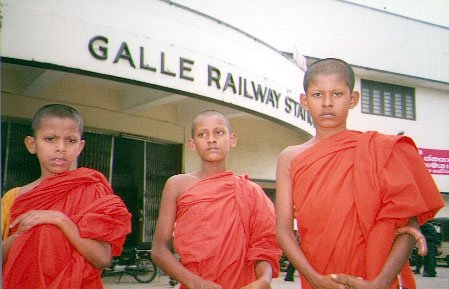
Young Buddhist monks outside Galle station.


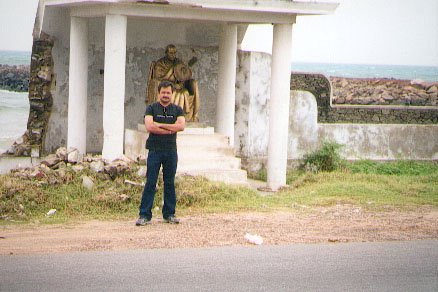
Yours truly posing by the Galle Road,
in front of a
tsunami-damaged monument.


Again on the road to Galle. The sea
behind killed about
20,000 in this
area alone exactly a year ago.


With one of the dare-devils who throng
the parapet of
the Dutch fort at Galle,
offering to jump into the ocean for money.


A daredevil jumps into the ocean.


Tsunami is past. Time to buy Lux


Sri Lankan beauties!

Monday, December 19, 2005

Of Women And The Drops In The Ocean

This evening, fate put its final seal of approval on two of my beliefs, both related to plane journeys: one, my luggage comes the last on the conveyor belt; and two, I will never have a woman sitting next to me. This evening another plane ride ended: plane load of women, but none next to me.

It's one thing to take a woman along on a trip, but quite another to find one -- a total stranger -- sitting next to you. Eyes meet, elbows touch, conversation happens; and if you are in luck, she might even ask for your card. Even if she doesn't, and just says goodbye at the end of the journey, you have at least had a good time. At least you don't pay attention to the jerks and jolts during the take-off or landing or when the plan hits an air pocket.

The absence of a woman companion doesn't pinch you so hard during the onward journey, as it does on the return. Because during the onward journey, there is still some hope that you might find someone on the return flight. But when a puzzled-looking man's hunt for his seat ends on the empty seat next to yours, that hope is killed too. You feel like tearing your hair.

That is why I was in a sour mood on the flight from Colombo this evening. The problem, for me, is not just the lack of women. Interesting men can often make up for that. But by some strange twist of fate, I am invariably saddled with men who barely make conversation, the reason for which becomes clear shortly before landing: they shyly push their disembarkment form towards me and ask me to fill it for them. This -- let me admit it -- makes me feel as smug as a woman's company would have. This is my destiny, in any case.

Now a little about how I almost missed the flight. Rather how I thought I would miss the flight. Bentota, a sea-side town where I spent two nights, is about three hours away from Colombo airport, which itself is a good hour and a half from Colombo, the city. So I started from Bentota at 1.30 pm in order to be in time for the 7 pm flight. The taxi breezed through various small towns -- Kaluthara, Mt Lavinia and so on -- but when it hit Colombo, it began to move at a snail's pace. Traffic was thick and refused to move. 3.30 pm already and, ideally, I was supposed to report by 4. The airport was still 20 km away.

I began to have visions of spending yet another night in Sri Lanka, this time not in the comfort of the Taj hotel, but maybe in the airport itself, provided they booked me in the next flight and allowed me to hang around for the night. Worse, the local ATMs showed PIN error whenever I inserted my card, so not much money either. But luck knows how to compensate: I was in the airport at 4.20 sharp. I was one of the first passengers to report.

In hindsight, I could have saved those 20 extra minutes and prevented myself from building up to a near-heart attack. Only if I had not taken that detour in Colombo.

Before going for lunch at the hotel restaurant in Bentota, I thought of pouring myself a drink. A drink is what I wanted after a rejuvenating Ayurvedic massage. One drink led to another, then another, and yet another. Then a quick lunch and a goodbye to the hotel staff. But they wouldn't let me off without a glass of the king coconut water.

We were barely out of Bentota when I could feel my bladder filling up. I mentioned my condition to the driver but his English was no better than my Sinhala. He just grinned. In India, when you drive a distance of 65 km or so, you are bound to come across open spaces or at least unattended walls on which you can relieve yourself. But here there were none. One town led to another, and whatever walls you drove past belonged to either some shop or a respectable insititution. Had I been in India, I would have considered it my birthright to ask the driver to stop by one of these walls so that I could get lighter. But I saw not a single soul facing these walls with one hand invisible -- a common sight in India even in the heart of a city.

Finally, I decided to be more explicit. "Please stop at a toilet," I told the driver, raising my little finger. He finally seemed to understand because he grinned and nodded. But he didn't stop: there was no place to stop. I gritted my teeth and kept shifting on my seat. At last we hit Colombo, and the driver turned left from the highway into a lane. The lane opened up to the sparkling blue waters Indian Ocean. But between the ocean and the end of the lane are a pair of rail tracks, and I thought the driver would say, "Do it on the rail tracks." I was mentally preparing myself to do it on the rail tracks when I noticed a few lovebirds walking on those tracks, hand in hand.

No, no -- I told myself -- I can't spoil the scene for them, especially in a country where nobody seems to be peeing in public. Even the driver didn't want me to do that, for he directed me, "Cross the tracks, cross the tracks, do it in the ocean." Ocean: The word sounded so mighty!

I climbed up the shrubby elevation, crossed the two tracks, and reached the sandy stretch wetted moments ago by furious waves. There, I relieved myself -- an exercise that seemed to last forever. When I zipped up and began to return, I recalled the adage: Each drop makes the ocean. Maybe now I know why it is called the Indian Ocean. It takes an Indian to make that ocean. Sri Lankans, who are the ones to be truly surrounded by the Indian Ocean, are too shy and sophisticated to contribute to its volume.

Friday, December 16, 2005

Bookworm, Sleepworm And Pancham

A couple of days ago, I posted something titled Of Mice and Men (scroll down a little to read that in case you haven't). In that I presented an imaginary situation where I am seeking to, well, make love on the first night to a wife who happens to be a bookworm. People who left comments said they had a good laugh when they read my stuff, though one of them said I was stretching my imagination a bit too far.
To be honest, I was neither laughing nor did I have the intention of making people laugh when I wrote the piece. For me, the scenario of a husband making love to a wife who is totally immersed in her book, even at the time of the sexual act, can be very real life. I have seen at least one marriage break down because of the woman's love for books (a man professing his love for books at the wrong moment can be equally disastrous). This woman, a former colleague now, stacked up books even in her wardrobe. And once she had started reading a book, it was amost impossible to draw her attention away. Her husband put up with her for two years before deciding to file for divorce.
Today, another kind of indulgence came to light. A friend's friend, who happened to read this blog, confessed about being guilty of doing something similar. She confided to my friend: "I am not a bookworm, but you can call me a sleepworm." Her story: when her husband makes love to her, she dozes off occasionally. The husband panics, thinking she has passed out. He pats her cheek to make sure she is fine: she is fine enough, only that she is too tired and has fallen asleep.
While my friend was narrating the story, I imagined this scenario about her friend:
He (while still at it): Tum so gayi kya? (Did you fall asleep?)
She (waking up): Tum aa gaye kya? (Did you come?)
And they both go to sleep happily ever after. I mean they both go to sleep happily after that.
Anyway, enough scenarios about sex. I think one should just let people be. Only that I don't want my would-be wife to be a bookworm or a sleepworm. With that thought, I would like to sign off for a few days. I am going away to recharge my batteries. The persistent rains in Chennai have completely drained me out: I have never felt gloomier. The sole source of warmth during the wet season was this small family of bloggers I have out here. Thanks, all of you, for your kindness.
I do not know if any of you is going to miss me while I am away. But for those who are nice enough to spare a thought for me, I am going to leave behind a few thoughts about R D Burman, also known as Pancham. Pancham, as those who love him know, was not just a composer but is a way of life. There are people whose evenings are incomplete without Pancham, and people whose days are made because of Pancham.
Pancham never disappoints. For the day when it is raining, he has Rimjhim Gire Saawan, Sulag Sulag Jaye Man. For a romantic night, he has Aapki Aankhon Mein Kuchh Mehke Hue Se Raaz Hain. For teenagers, he has Khullam Khulla Pyaar Karenge Hum Dono. He has something for everyone. There are exceptions, of course -- people who think Pancham copied from the West. But these are people who are never into Hindi music in any case, and who set out with the notion that Hindi music is inferior to what those guys make in the West.
Well, Pancham did lift some of his songs from the West, but at least he gave those lifts an Indian ambience, an Indian touch -- no mean feat. In any case, Pancham is not remembered today because of those few songs inspired by or copied from the West. He is worshipped today because of the manner he blended the soul of the West with that of the East, blended tradition with technology, blended classical with the contemporary. A copycat dies a quick death, but Pancham, even 11 years after his death, remains the most popular music director of the country. He still sells more than anyone else. Ask your nearest Music World outlet and they will tell you.
Pancham, the human being, will be remembered soon, on January 4 -- his eleventh death anniversary. For a few years, year after after, I wrote a tribute every January 4-eve, more as an exercise to justify my admiration for him. Now I no longer feel the need to justify: the world seems to be agreeing with me. But nothing prevents me from reproducing what I last wrote about him -- just to celebrate that justification on the eve of the death anniversay. This is what I wrote in January 2003.

Wednesday, December 14, 2005

Remember December 6?

This morning I sat down to edit a correspondent's copy when my eyes fell on the date it was filed. My eyes paused because the date seemed too familiar: December 6, the day 13 years ago Babri Masjid was flattened in Ayodhya and the course of Indian politics took a decisive, and a divisive, turn.

Since then, various political and religious groups have been observing December 6 as the 'day of victory', 'day of pride', 'day of shame', Black Day, and so on. But this year, the anniversary went completely unnoticed. When there is so much else happening -- cricket in politics and politics in cricket -- who would care to remember December 6?

But I don't think the anniversary was ignored just because of other preoccupations. I think the people of India have matured and moved on. They have better things to do. Even the people of Ayodhya are desperate to move on but they, sadly, are still caught in the mandir-masjid dispute. I was in Ayodhya last year while covering the 2004 elections in Uttar Pradesh. I would like to share what I wrote then. I wrote this and this.

Salt And Sugar

Last Saturday, I was at a friend's party where I met a producer who narrated an anecdote to me. He is making a Hindi film which is being shot in Chennai and which has Shakti Kapoor on the cast.

No matter what others might think of Shakti, I simply love that man -- his mannerisms, his accent and, above all, the way he gets startled in the movies each time the hero springs a surprise on him. He just makes my day. And who can forget the trademark "Aaaooo!!" -- the sound that the wide-eyed Shakti spat out before mouthing each of his dialogues in Tohfa, starring the hit trio of Jeetendra, Sridevi and Jaya Prada. So when the producer mentioned Shakti Kapoor, I pestered him for more information. That's when he narrated the story.

Shakti Kapoor was staying at the Taj Connemara. Unlike many other stars, Shakti does not throw tantrums and even brings his own Scotch. So one evening before he settled down to drink, he opened the mini bar to look for eatables. There was a pack of peanuts (or was it wafers?), but Shakti's popping eyes popped out even further when he saw its price on the menu card: Rs 100 (he must have given the packet his trademark startled look, and might have also exclaimed, "Aaaooo!" But one can't verify that). A hundred rupees for a pack of munchies was too much, he decided, and off he marched to the Foodworld at Spencer Plaza, which is literally a two-minute walk from the hotel. There he bought five packets of the same munchies and walked back to the hotel. On his way back, of course, there were many fans who gave him company. How I wish I was one of them.

The morning after this party where I heard the Shakti Kapoor story, I went to the neighbourhood store to buy cigarettes. The owner of the store has become a good friend: he never lets me leave without ordering tea for me from a shop which is just across the road and which is also owned by him. That Sunday, over tea, he told me a story.

There is a man working in an office nearby who, according to my friend, has tea five times a day from that shop. But the man is a diabetic. In normal course, a diabetic, when ordering tea, says: "Don't put sugar in mine." But this man always says: "The sugar you are about to put in my tea, just parcel it for me." End of the day, he must be having quite a quantity of sugar to take home.
Technically, the man's demand is valid: he is entitled for those two spoons of sugar, and if he doesn't want them in the tea, he can always carry them home. But I have never, ever, come across anyone doing something like that. When I mentioned this man's habit to a friend, her reaction was : "How sweet!"

Do you, by the way, see any similarity between this man and Shakti Kapoor?

Monday, December 12, 2005

Of Mice And Men

Tonight after I switch off the laptop I am going to read Alchemist, a book which, I am ashamed to say, I have never read till date. My sense of shame deepens every time I see it mentioned on a blogger's profile as one of his or her favourite books. But a random thought is crossing my mind at the moment and I cannot resist putting it down here: What if I marry a bookworm who loves books more than anyone or anything else?

The positive side is that all my books will be taken care of. My grandchildren would not need spend money on buying any of Maugham, Hemingway, Steinbeck or Naipaul: they will inherit the collection. But not all children or grandchildren are considerate. My brother recently picked up the entire collection of Hemingway, for Rs 20 each, from a pavement in Kanpur. Each of the books had the same inscription: "To my Sona, from dear Baba." The date inscribed was sometime in 1986.

My commonsense suggested that it was a Bengali man who had gifted the books to his daughter, because fathers are usually called Baba by Bengalis, and daughters are often lovingly called Sona -- literally meaning gold. I don't know under what circumstances the books found their way to the footpath, but I shudder to imagine a similar fate for my own collection which has been built, with my hard-earned money, over several years.

Anyway, that's digressing from the subject. Why agonise over distant future? The thought that had come to my mind was what if my going-to-be wife happens to be a bookworm. I can imagine this scenario when the clock strikes eleven and when (Indian) couples usually initiate what they are supposed to do on the first night of their marriage. I enter the room and shut the door behind me. She has been waiting for me. The conversation begins.

Me: Tonight, darling, a new chapter begins in our life...

She: (Supine on the bed in her bridal finery) One second, let me finish this chapter, please ... Er, have you seen off all your friends?

Me: Yes, they have all gone home to their wives. And here I am, finally with my wife...

She: Oh darling, you are such a sweetheart... Have you read Of Mice and Men? That is another great book Steinbeck has written. It is there in my father's place, I will get it for you. Now let me finish this chapter honey (blows a flying kiss).

Me: Oh you smell so good...

She: Doesn't it?! Oh I love the smell of fresh ink! Here, smell it (she holds the opened pages of Grapes of Wrath to my nose. I grab the book from her).

Me: I wish I could run this rose bud along your spine... How will it feel?...

She: Hey, hey, don't put the book away like that, you will break its spine! (Grabs the book back and caresses it. I begin to caress her. She continues to read).

Me: You are so beautiful...

She: It's a beautiful story, I told you... Are your friends gone?

(By now I start doing what a man is supposed to. Her legs cooperate, but her hands are still holding the book and her eyes are on its pages.)

She: Are you done?

Me: Yes.

She: Did you come?

Me: Yes.

She: Good. Now lie down next to me like a good boy and let me finish this chapter. Just remind me to get you Of Mice and Men. You must read that.