Come Durga Puja, their creations will hold the entire city of Kolkata spellbound for five days. Yet, for the artisans on the banks of the Hooghly, it is just a means of survival. BISHWANATH GHOSH watches as the gods take shape under their skilled hands...
“You are taking pictures,” Bikash Mondal warns from his perch, “you'll have to give us money to buy tea.” Standing atop a wooden platform in a workshop that is crammed with incomplete clay images of the goddess, the elderly artisan, clad only in a soiled lungi, is preparing to install the head on the tallest of the idols.
His warning is only half in jest. This is, after all, a back-breaking time for the artisans of Kumartuli, one of Kolkata's oldest neighbourhoods, nestled on the banks of the Hooghly, which provides the city its greatest source of joy — idols of Durga. There are barely three weeks before the goddess transforms from a crude structure of clay-and-hay to a beautiful, bedecked Bengali bride and reaches the countless pandals of Kolkata. Distractions, therefore, are not welcome.
It is almost five in the evening when I arrive in Kumartuli. But Rabindra Sarani, its biggest road, bears a deserted look. Most shops are shut. The absence of traffic lays bare the pair of glistening tram lines stretched out on the road. Running on them now, however, are not trams but the occasional taxi and autorickshaw and, of course, the human horses — lungi-clad, weather-beaten men pulling rickshaws with the strength of their bones.
Is it a public holiday? Not that I know of. Or is it that the shops in Kumartuli close in the afternoon for a post-lunch nap? I'm not sure of that either, though that is more likely. But stroll into Banamali Sarkar Street and the languorous air melts into a buzz of activity. This narrow street is the nerve centre of Kumartuli, flanked by cavernous workshops that are packed with large idols of Durga and her four children in various stages of completion. Wiry artisans squat on the street, kneading the clay or working on smaller idols, ignoring the attention of curious passersby and amateur photographers. That their creation is going to leave Kolkata gaping in admiration for five full days is of no consequence to them — for them making gods is only a means of survival.
The workshops of Kumartuli — there are about 450 of them, many of them concentrated around Banamali Sarkar Street — are run by families that have been into idol-making and pottery for generations: Kumartuli means potters' quarter. During the Puja season, they hire extra hands from across Bengal because making the idols of Goddess Durga is a grand affair. The goddess, after all, does not like to be presented alone in a pandal: she must be accompanied by her four children, not to mention the lion she rides and the curly-haired, muscular demon she is shown slaying. And with new settlements coming up around Kolkata and with Bengalis reaching newer shores across the globe, the demand for idols has gone up over the years. Kumartuli is known to create close to 4,000 sets of Durga idols every year, some of which are shipped abroad. All this calls for a lot of work — work that demands intricacy and, very often, creativity.
The flash of my camera may have irritated the elderly, bare-chested artisan who is trying to fix the head on a 12-ft statue of Durga, but his employer, Nanigopal Rudra Pal, is in a meditative state as he works on the goddess' fingers. Strewn on his table are a set of clay fingers, each large enough to befit the 12-ft idol. He is picking them up, one by one, and delicately running his fingers on them to impart them his masterly touch, to make them look as human as possible. The fingers look very real — and a bit spooky.
“I have been in this business for 45 years now,” says Pal, now 68, without even looking up to see who he is talking to. He is too engrossed creating the nail on a thumb of the goddess. So how many idols is his workshop making this year? “Twenty, may be 25?” I decide to leave him alone, and find someone chatty.
Out on the street, in an isolated corner, one artisan is busy applying clay on the protruding belly of Ganesha. He is Gobinda Dey, who has come from Nabadweep. A typical Kumartuli idol, he tells me, is made of bamboo and hay — the bamboo serving as the skeleton and hay the flesh. Once the structure is ready, it gets a skin of entel maati, a sticky variety of clay procured from the bed of the Hooghly. Once it dries up, the finishing touches are given with bele maati, a finer variety of clay which also comes from the river. The idols are always pre-ordered and never sold off-the-shelf.
“I've been making idols ever since I was 18 or 20,” Gobinda, now 40, tells his story without stopping his work. “It takes about four days to create an idol” — he is talking about the goddess' children. “But Durga's idol takes about a week. Each year I make about 20 idols.” I ask Gobinda if he always wanted to be an idol-maker.
“I didn't have a choice. Lekha-pora to sikhtey paareni (I could not get education). This profession may not give me a good life, but it gives me what I need — two square meals a day. I have no one to look after; my parents are dead and I am single. So I am able to manage,” he says.
So how much does he earn during a season? Gobinda does not give a direct answer: uneducated he may be, but he is clearly aware of the never-ask-a-man-his-salary rule. “It all depends on skill and experience. Some of us get Rs. 1,000, some get Rs. 2,000, some others a little more. Food and lodging are provided by the employer.” A pittance, but, as he says, they don't have a choice.
I saunter along the street: never before have I seen so many idols at the same time. One set of idols sit right next to a public urinal: I guess it does not matter. Until they reach the pandals, they are not gods but just images of clay and hay. Three weeks later, a multitude of people will be standing before the same idols, with their hands folded and a silent prayer on their lips.
I am standing by the Hooghly now, its waters darkening in the rapidly fading light. The bell of the riverside temple rings. A group of labourers, wet from the river, has just deposited a boatload of black clay on the banks. From this mound, the clay will be scooped and taken to the various workshops. Two more clay-laden boats are approaching. All this for five days of festivity, after which, the idols will be consigned to the river. The clay will dissolve and return to where it belongs.
Published in The Hindu Sunday Magazine, 18 October 2011.
Sunday, September 18, 2011

In Carnival Mode
Kolkata has many faces but during Durga Puja there is no space for anything else but celebration ... and a little bit of sadness
What you think of Kolkata depends a lot on how you come to Kolkata. If you come in a train and alight at the Howrah station, you will drive into a city that is a prisoner of its long-standing image — the iconic bridge, trams, hand-pulled rickshaws, stream of labourers propelled into a half-run by the heavy load on their heads, pavements turned into kitchen by poor migrants, crumbling colonial-era buildings giving off a whiff of heritage and decay.
But if you fly down to Kolkata and take the Rajarhat Road into the city, you could be rubbing your eyes in wonder. You will tear through a global-era landscape: upscale high-rises, state-of-the-art offices of IT giants, snazzy malls. North Kolkata, where the city originated, may continue to be a living museum of the olden times, but the metropolis, on the whole, is no longer what you saw in black-and-white Bengali movies. Unemployment is no longer a burning issue. There was a time when high school students, during their exams, were asked to write essays on the subject of unemployment. Load-shedding is a thing of the past. Traffic jam, once Kolkata’s best friend, has now become the principle foe of other cities. And Kolkata today has a night life like no other city.
But come Durga Puja and it does not matter what route you take to Kolkata. No matter what your mode of travel, you arrive in a city where celebration is the uniform civil code. From whichever corner you look at it, you will find nothing else but puja pandals, food stalls and a multitude of people out on the roads until the wee hours. It’s carnival time. It’s a religious event, cultural occasion, music season, literary fair, food festival, fashion show — all rolled into one. Many of the popular songs of R.D. Burman that you listen to today were originally recorded in Bengali as part of Puja albums. And the story for many a celebrated Bengali film had been originally written for the Puja-special edition of local literary magazines.
There is, however, a gloomy side to Durga Puja. Bengalis, even though they wait for it all year, actually become very sad once the Pujas begin. Even while they enjoy the five days of festivity, they are also extremely mournful about how quickly it is all going to end. On panchami, they realise that only four more days are left. On sashti, it strikes them that just three more days are left. By saptami, the heart is heavy. On ashtami, there is a lump in the throat. By the end of navami, there are tears in the eyes. They are left with no choice but to look forward to the next year’s Puja. It is the looking forward that keeps Kolkata going. As they shout while taking the idols for immersion: “Aaschhe bochhor abaar hobey (we are coming back next year)!” It’s Kolkata’s way of assuring itself that the party is not over yet.
Published in The Hindu Sunday Magazine, 18 September 2011.
Saturday, September 17, 2011
In the state of Paschimbanga, a slice of Pondicherry

The sun, as it began to set, sprinkled the river with drops of orange; the sky, meanwhile, was rapidly turning into a patchwork of grey and deep blue. A number of elderly men, sitting on archaic wooden benches in groups of twos and threes, were watching the spectacle. For them it was not a spectacle but a sight they came across every day after their evening walks on the Strand in Chandannagar, once known as Chandernagore. But for us it was — and we had made it just in time to watch the sun set over the erstwhile French colony.
It takes roughly an hour to reach Chandannagar from Kolkata, but it took us three. The reason being my two companions got into a heated debate and forgot all about the crucial right turn that had to be taken in order to reach the tiny town located on the banks of the Hooghly. And since the debate, inspired by a new Bengali film called Iti Mrinalini, was about extra-marital relationships, the driver must have had his ear placed on the conversation so firmly that even he forgot to take his foot off the accelerator. The car kept speeding forever on the wide, smooth Delhi Road.
By the time we realised our mistake, we were way beyond Bandel, another town further up the Hooghly which boasts of a Portuguese-built church dating back to 1599. Moral of the story: discussing extra-marital affairs leads you nowhere. We made a U-turn and took the next visible road turning left, and were soon on the historical Grand Trunk Road, travelling downstream alongside the Hooghly. The road, built by Sher Shah Suri, which runs from Sonargaon in Bangladesh right up to Peshawar in Pakistan via the fertile Gangetic plains of India, assumes the form of a narrow lane at many places in this part of Bengal. Only upon reading the various signboards — the signboard of the neighbourhood doctor's clinic, of the local grocery store, of the crowded sweet shop — did we realise that it wasn't the lane that was small; it was actually we who were crawling like an ants on the lap of history.
In hindsight, the debate turned out to be a blessing. Had we reached Chandannagar a little earlier, we would have been caught in the rains. We might have turned the car back and thought of returning some other day — it's a day that never comes. But right now the town was freshly bathed — all set to welcome us and also draw its residents out of their homes. It was time for their evening walk.
As far as looks go, the similarity between Chandannagar and Pondicherry is unmistakable. While Chandannagar has the river, Pondicherry has the sea — that's the only big difference. Though Pondicherry, having been the capital of French India, has far more French-built buildings on the waterfront than Chandannagar, the atmosphere that prevails in the evenings is strikingly similar: people out on their walks, young women commuting on bicycles, hawkers selling ice-cream and local savouries. There is definitely something French about women riding bicycles — it's a common sight in Pondicherry as well.
What is, however, definitely Indian is the urge to have a steaming cup of tea and something freshly fried when the air smells wet. And so, before walking the length of the Strand, we parked ourselves on a bench in front of the eateries that line the short road connecting the Strand to the Sacred Heart Church, built in 1875. The three of us had hot cutlets, both mutton and vegetable, followed by tea served in miniature earthen cups. The bill: Rs 25.
Chandannagar's modern history dates back to 1673 when the French obtained permission from the Nawab of Bengal to set up a trading post on the banks of Hooghly. Bengal was then part of the Mughal Empire. Over the decades, the traders went on to become rulers — now that's a familiar story, isn't it? In 1730, Joseph Francois Dupleix was sent from Pondicherry to take over as the new governor of Chandannagar; and under him the town developed and prospered so much that he was soon sent back to Pondicherry as the governor-general of French India. Dupleix is best remembered for his rivalry with Robert Clive of the British East India Company. In the end Dupleix lost and Clive won, as a result of which Pondicherry lost out to Madras and Chandannagar lost out to Calcutta in terms of their importance as towns.
And what if Dupleix had won? Perhaps this piece would have been written in French.
Dupleix's home, still intact, continues to be the most prestigious building on the Strand. It is under the protection of the Archaeological Survey of India: part of it is a museum and part of it serves as an institute where you can learn French. In the museum you still get to see Dupleix's four-poster bed — so tall that it could be climbed only with the help of a small wooden stairway that also stands preserved alongside the bed. Another landmark on the Strand is St. Joseph's Convent, a girls' school founded in 1861 by the Sisters of St. Joseph of Cluny. It continues to be one of the best educational institutions in the country and its alumni, today, is spread across the world. I get to see two of them on a daily basis — one at work, a colleague; and another at home, my wife.
Even as you gaze admiringly at these buildings while walking on the promenade, it is impossible to miss the sights offered by the other side of the Strand — that of the tree-lined river bank and the river itself, flowing serenely towards the mouth of the Bay of Bengal. And across the river, you see the chimneys of jute mills rising above the green vegetation, piquing your curiosity about what lies on the opposite bank.
A one-way ferry ride costs three rupees each. We got into a steamer and climbed to the upper deck with the intention of getting a view of the river against the receding town, but a man stopped us and directed us to the lower deck, where we sat face-to-face with the daily passengers — mostly office-goers returning home. One of them sensed our discomfort and remarked, “It will take exactly three minutes.”
It was precisely in those three minutes that night descended; and on the opposite bank, by a temple, rickshaw-pullers waited to take passengers up the darkened path. Since we had no particular destination in mind, we lingered around the temple and ate peanuts. The peanut-seller once worked in a jute mill that has now closed down — another familiar story, isn't it?
When we returned to Chandannagar, the promenade had turned into a venue for addas. Elderly people in small groups were plunged in discussions — one group was discussing Anna Hazare. Young girls were dismounting their bicycles to greet known faces. The hawkers were out in force — selling ice-cream, jhaal muri and paani puri.
On our way out, one of my companions suggested that we stop by at the legendary sweet shop of Surjya Kumar Modak. It was another way of saying — a trip is incomplete without dessert. There we gorged on freshly-made sweets: maal-pua, sandesh, rabri and rosogolla. Needless to say, food turned out to be the subject of discussion on the journey back to Kolkata — a subject that, if you are a true Bengali, is any day more interesting than extra-marital affairs.
Published in The Hindu MetroPlus, 17 September 2011.
Friday, September 16, 2011
Life In A Metro: In Pursuit Of Parking
Earlier, happiness meant owning a car. Now, it's finding a spot
I have been living in Chennai for 10 years now – I had arrived just in time to watch the city transform. Had I come a few years earlier, I would have been too old-time a resident to notice the changes; had I come a few years later, I would have landed amidst the change and would not have noticed it.
The thing I loved most about Chennai when I came to live here in early 2001 was my street – a clean and tree-lined stretch of road where you could only hear silence even though it's a stone's throw from the cacophony of T. Nagar. No matter what time of the day, the street would be empty, and when viewed from either end, would resemble an elongated arbour. I would often climb down my house and stand on the street just to meditate on the silence and listen to the birds – it made me love Chennai.
Today the same street resembles a parking lot. Throughout the day, cars and bikes are parked on either side, not only narrowing the once-handsome street but also causing traffic jams each time two large vehicles come face to face. The street that, not too long ago, had no traffic now witnesses frequent jams! Now that should give you a fair idea about what's going on in the rest of Chennai – considering that nearly 1,000 new vehicles hit its roads every day – and in other cities as well.
Time was when buying a car brought you happiness and gave you a sense of achievement. It was one of the milestones of life – once you crossed it, it meant you were on the road to prosperity. But today, we even have cars that are specifically made for the common man – the idea is no one should be without a car. And so, overnight, the meaning of happiness has changed. It's finding a parking space that now brings you joy and gives you a sense of immense achievement. (Possessing a car, on the other hand, only reminds you of the number of instalments that still remain to be paid.)
Today when you go to watch a movie at a multiplex, parking the car turns out to be a greater event than the movie itself. Once you are home, the scenes that play in your mind are not from the movie but from the parking lot. And I have lost count of the number of times my wife and I had to abandon the plan to watch a movie simply because a sign at the gate of the mall would read: Parking Full.
And yet, we watch wide-eyed the advertisements for cars, little realising that cars are slowly making us unsocial. It's just a matter of time before we completely stop visiting people or inviting them over: we can park ourselves on couches, but what about our cars!
Isn't it time we had companies that manufactured parking space? I guess it won't be very long before some enterprising companies actually begin doing that. And if that ever happens, you don't have be a rocket scientist to predict that space will cost more than the car. Imagine watching on TV a commercial selling space – how do you show a thing that cannot be seen!
This column is, in fact, inspired by an incident that took place last evening. The wife and I were at the basement of a mall, snaking along the rows of parked cars, trying to find a slot. Following us was a line of cars, in search of the same elusive thing. Suddenly my wife, who was driving, spotted a narrow vacant slot that we almost drove past.
“Quick, quick!” she told me, “Just get out and stand right there while I back the car.” Her idea was that if I stood there, I would automatically lay claim to the vacant space. Even as I considered whether I should actually do that, the car behind us slithered into that spot. She has not been talking to me since.
Published in The Hindu MetroPlus, 17 September 2011.
Thursday, September 15, 2011
Perception

I don't remember since how long S.S. and I have been drinking together. Wait a minute, I do. It's ten years now. If drinking were a creative act, we would have both been celebrated members of the society by now -- the amount we have drunk together! But who says drinking isn't a creative act? In fact, it can be the most creative if done in the right company.
The best part about S.S. is that he is not a fussy drinker. Very much like me. I know men who drink only beer and nothing else. I know men who drink only wine and look down upon other varieties of alcohol. I know men who can drink their whisky only with soda and their rum only with cola. Some can't drink without ice. Some others are very particular about 'side-snacks.'
S.S., however, makes no fuss. Neither do I. As long as there is some water to pour in the drink, anything, just about anything, will do. Most of the drinking, all these years, happened either at my home or in the dingy, dirty bars of wine shops. Today neither of us goes to these bars for the same reason -- they are dingy and dirty. After all, there comes a time when you no longer do things that you did in the younger days and are better off with the memories of it.
But there was a time when we liked going to such places. I particularly liked it because here you met people who did not wear masks. They were what they were -- the labourers, the autorickshaw drivers, the small-time businessmen, the marketing executives, the medical representatives... And alcohol made them even more honest and human.
Very often, we would be approached by men in tatters. They would be holding out their alcohol-filled glasses and begging for some water. They would have managed to collect just about enough money to buy the alcohol, and had no money left to buy a pouch of water. When you are drinking out of habit and not as a social obligation, you always understand a fellow drinker's needs and compulsions. You are sympathetic.
But there is one sight I can never forget. Some years ago, S.S. and I were busy discussing 'office politics' over drinks when a bloodied hand clutching a plastic glass came in between us. One look at the man's face and I was horrified: he had a terrorised look on his face, his soiled shirt was coated with dust and the right sleeve was soaked in blood. He was begging for water.
There are countless such episodes I can recall if I try very hard, but right now they are as hazy as the previous night's antics under the influence of alcohol and I would rather let them remain that way.
But a few weeks ago, S.S. and I got together for a drink at a wine shop after God knows how long. Only that the wine shop was not in Chennai, but in a village in Andhra Pradesh, on the highway to Tirupati.
"I am free, man! Why can't I come with you?" S.S. told me when he learned that I was preparing to leave for a small town near Tirupati. "We could go in my car." So off we were -- the two old drinking buddies -- getting away from the city together for the first time. With each kilometre we travelled the smell of freedom grew stronger -- freedom from what, I was not sure.
At Thiruvallur, we lunched on freshly-fried Mysore bondas and Thums Up at a roadside stall. S.S. has a fetish for roadside food. Not that I don't, just that I am careful while making a journey. The man who was frying the bondas, obviously pleased with the number of bondas we ate, pointed to a road which he said was a short-cut to Tirupati. S.S., who blindly trusted the man's bondas, was reluctant to trust his sense of direction. I finally coaxed him: "Come on, man! This guy lives here. He knows better."
Obviously the bonda-seller knew better. Because even before we realised, we had crossed into Andhra Pradesh. S.S.'s eyes lit up when he noticed wine shops with Telugu signboards. For residents of Tamil Nadu who love to drink or who love their drink, every other state in India is a paradise. Tamil Nadu is the only state in the country where you don't get cans of Kingfisher beer (or any other beer) or Bacardi Breezers. In fact, you don't get anything in Tamil Nadu other than brands of hard, headache-inducing liquor that are unheard of in the rest of India. Why so -- no one seems to know or wants to know.
And so, we had entered paradise. "How about some beer, Ghosh?" S.S. asked me, overcome by glee. "May be when the next shop comes along," I replied. We were driving on a practically empty highway, cutting across lush green fields that looked greener under an overcast sky. And then, the first set of hills showed up on the horizon. The thing with hills is that they look very close but it takes forever reach them. As we drove on, believing they were just round the corner, a signboard came into view: Himalaya Wines. S.S. took his foot off the accelerator.
Himalaya Wines is the most picturesque wine shop I have ever seen or will ever see. On the face of it, it is just another well-stocked wine shop on the highway that is more eager to cater to commuters from the city; but in reality, it is a wine shop located in the middle of an unending stretch of green fields with the hills looking over. Its bar is nothing but a thatched roof shed where people from the nearby villages gather to drink. A thatched roof is all you can ask for in the middle of nowhere -- it was five-star luxury when compared to the dingy bars of Chennai which we once frequented.
We bought two cans of beer each -- S.S. bought Corona while I stuck to Kingfisher -- and settled at a table under the thatched roof. The attendant, seeing customers from the city, came running. We ordered omlettes and sundal. There was pleasure in every moment -- in holding the moisture-coated cans, in clicking open the cans and watching the froth form around the gaping holes, in tasting the beer that actually tasted like beer and not horse's piss.
We had just begun enjoying our beers when an elderly man, in crumpled clothes, walked up to us with his hand outstretched. "Oh no, not again," I muttered to myself, "and we don't even have water. We are drinking beer, can't he see?"
The elderly man came closer, his hand still stretched out. On his palm rested two bondas, and he was telling us something in Telugu. "What does he want?" I asked S.S. "We don't even have any chutney or sauce."
"Wait, let me find out," S.S. said as he got talking to the elderly man in Tamil. It so turned out that the elderly man was a farmer from a nearby village who was not asking for anything but was actually offering us something -- the freshly-fried bondas that he had bought from a roadside stall before walking into the wine shop.
"Since you are an outsider, he considers you to be his guest," the attendant, when he returned with the omlette and sundal, explained. "He has been coming here for years, but I have never seen him offer food to anyone."
Sunday, September 04, 2011
Life In A Metro: Flighty Thoughts
What goes on in the mind of a cattle-class passenger
Whenever I am on a flight, the most anxious moment comes when the plane is about to land. I am not alone, I'm sure. Horrible things are known to happen during landing, and I usually find a silent prayer involuntarily slipping out of my lips when the plane touches down.
It was no different last Sunday when, returning to Chennai after a pleasurable week in Kolkata, I held my breath as soon as the tyres hit the runway. I was eager to reach home safe so that I could pull out of my bag the large collection of books and CDs I'd bought from Park Street and look at them with renewed pleasure. A purchase is not a purchase until you've spread out the objects of desire on the bed upon reaching home for one final inspection before they become a part of your daily life.
The plane was still bouncing on the runway and I was yet to exhale in relief when I heard a cry from behind. “Excuse me, sir! Excuse me, sir!” It was the air-hostess who was strapped to her seat at the rear end of the aircraft. “Please go back to your seat! Please!” She was pleading, at the top of her voice, with a passenger who, within seconds of touchdown, had got up from his seat to retrieve his bag from the overhead compartment.
What surprised me even more was that the passenger – a bespectacled, thinly-built man who must be in his forties – returned to his seat with great reluctance, as if he did not like following the orders of a woman half his age. Had the plane been forced to take off again suddenly due to an emergency situation, he could have fractured his skull and died. It is not for nothing that the air-hostesses politely keep telling you to keep the seat belts on until the plane has reached the parking bay. But since they are pretty, petite and polite, you don't take them very seriously: replace them with menacing lathi-wielding police constables and you will find not a single mobile ringing during the take-off and not a single passenger unlocking the seat belt within seconds of landing.
But it's a very Indian thing: to defy rules if the rule enforcers happen to be of the courteous kind and if rule-breaking does not attract any penalty. We become like a classroom full of unruly students. There can't be a better example of this than the aircraft. No one seems to realise that the rules are for their own good, for their own safety. And yet, you will find passengers overcome by the sudden urgency to speak on the phone once they board – even though they had been idling their time away at the departure lounge. I guess for most of them, it is the thrill of being able to talk from the aircraft.
It no longer surprises me when phones continue to ring even after the pilot has announced, “Cabin crew, prepare for take-off.” What really surprises me is the scene inside an aircraft after landing. Though not many display the courage to get up from their seats while the plane is taxiing towards the parking bay, almost all passengers are up on their feet the moment the plane comes to a halt.
There is usually a long wait, which can extend up to twenty minutes, before the ladders arrive and the doors open, and yet passengers give up the comfort of their seats and stand up, often craning their necks under the overhead compartments, as if that would hasten their exit. At that point, the plane does not look like a plane but a truck packed with cattle. Cattle: doesn't the word sound familiar?
Published in The Hindu MetroPlus, September 3, 2011.
Friday, August 26, 2011
Life In A Metro: Oh! Calcutta!
A letter from the capital of Paschimbanga (or West Bengal, as you knew it)
“Twenty minutes to touch down,” announced the captain, and I looked down the window to find the plane hovering over the city – a maze of luminous dots. So where was I going to land – in Kolkata or in Calcutta, in the capital of West Bengal or in the capital of Paschimbanga?
To me it made no difference. When I speak in my mother tongue, I instinctively refer to the city as Kolkata – like any other Bengali. When I am talking to a non-Bengali, I find ‘Calcutta' automatically rolling off the tongue. Likewise, I am as familiar with West Bengal as with Paschimbanga, which is merely the literal translation of the English name and has already been in use for as long as one can remember. Therefore, I don't see the change from West Bengal to Paschimbanga altering the life of the Bengali in any manner. But when I land, even though the temperature is a pleasant 29 degrees, I find Kolkata sizzling with arguments over the name-change. I have arrived just in time to catch the city engaged in doing what it loves to do best: debate.
The warmth of North Calcutta or the sophistication of South Calcutta? Shiraz biryani or Arsalan biryani? Mohun Bagan or East Bengal? Sourav or Sachin? Suchitra Sen or Supriya Choudhury? Uttam Kumar or Soumitra Chatterjee? Satyajit Ray or Ritwik Ghatak? Feluda or Byomkesh? Presidency College or Jadavpur University? Darjeeling or Puri? These are perennial debates that divide Kolkata, or Calcutta, into two fiercely independent nations. Perhaps it's only appropriate that the city and the state have two names each – one official, another universal.
Food for thought
In Kolkata, food is not only an integral part of any event worth celebrating, but is a celebration by itself – for which you need no particular occasion. Food columns, supported by high-resolution (read mouth-watering) pictures of preparations, are a prominent feature of every newspaper worth its salt; food festivals are usually the talk of the town, and food alone can rival the female form when it comes to the selling of a product through advertisements. At restaurants, any meal is incomplete without a passionate discussion about the food served to you. You should be able to tell whether the fish is good or not so good, or whether the lamb is as tender as it was the last time you ate there. You are considered lowly if you don't have an opinion to offer. Kolkata, after all, is a city of opinions – everybody has one, about almost everything under the sun.
The other day, I went with a group of friends for lunch to Oh! Calcutta, an upscale restaurant that serves authentic Bengali cuisine. The conversation at the table went rather smoothly until the arrival of the hilsa, which sparked off a debate: was the fish locally procured, or had it come from the river Padma in Bangladesh? One faction said the hilsa was too good to have come from the Indian side of the river, another faction countered that they'd had hilsa that tasted just as good as the ones from Padma. Since I don't eat fish, the discussion made no sense to me and was, in fact, getting on my nerves. I called the waiter and asked him: “Is this Padma hilsa or local hilsa?” He disappeared into the kitchen and returned after a few minutes to announce that it was indeed the Padma hilsa. Suddenly, a gloomy silence descended on the table. I realised my blunder: by putting an end to the discussion, I had made their meal bland.
Did you know?
As of this moment, theatres in Chennai, where I live, are showing about half-a-dozen English movies. But in Kolkata, which was once the capital of British India and where a large number of people still preserve the English way of life, only two English films are being screened in multiplexes: Harry Potter and the Deathly Hallows and Spy Kids 4. “I so badly wanted to see Rise of the Planet of the Apes,” a local friend, who is heavily into sci-fi, complained. “But they only show children's films. I wonder why.” Even I wonder why.
Published in The Hindu MetroPlus, 27 August 2011.
Saturday, August 20, 2011
Life In A Metro: Life In A Lodge
It's not so bad, sometimes, to forsake the big city for a small town
Money – as the Beatles and countless sagacious souls have said – can't buy you love. There is something else that money can't buy, and that's a decent hotel or a lodge in a small town. By decent I don't mean five-star luxury when you have to tear off a white ribbon to even lift the toilet seat – but a clean and comfortable bed and a clean and functional bathroom.
Cleanliness and comfort don't seem to figure very high in the priority list of people who run hotels and lodges in small towns. It's almost a rule that the bed-sheet should bear stains, the tap should leak, and the curtains, if there are any, should smell. The sentiment behind this deliberate oversight seems to be: “This is just a halt, not a home. Why invest in giving guests the feel of home when they are going to check out the next morning anyway?”
You have no choice but to check into one of these lodges, for a measly tariff that can be as low as Rs 150 a night. Even if you are willing to spend Rs 1,500 a night – which is, again, peanuts by city standards – you have no choice but to check into a smelly room for Rs 150 because that may be the only lodge the town boasts of.
Why should anyone, in his or her right mind, leave the comfort of a home in the city and travel to a small town to check into a mosquito-infested lodge? The answer is simple: necessity. You could be a young MBA graduate peddling biscuits, or a journalist collecting material for a story, or a pilgrim visiting a temple – there comes a time in life when a train or a bus deposits you in the lap of an otherwise unknown town and when the first thing that crosses your mind is, ‘Where do I stay?'
By now, I am a veteran of such occasions, though this is nothing to boast about – or maybe it is. The cheapest place I've stayed in was a lodge in Mughal Sarai, in eastern UP, where I checked in at four in the morning. I paid Rs 180 for a filthy, mosquito-infested room lit up by a candle (because of frequent powercuts), and where the leaking tap in the bathroom kept making a sinister sound all night.
The strangest lodge I've ever stayed in was one in Jolarpet, where the drainage mesh was located right in the middle of the bathroom floor. Each time you had a bath, you had to step over a frothy, circular puddle that would have formed at the centre of the floor. The dirtiest experience, however, has to be the lodge in Arakkonam where, after settling into an air-conditioned room (which itself smelt like the godown of a scrap-dealer), I made horrifying discoveries in quick succession – used toothpicks shoved under the edge of the mattress, the bathroom bearing muddy footprints, and the toilet seat lying on the floor.
Once, in Nagapattinam, a small army of taxi drivers stood in my room and watched a movie that I was playing on a borrowed DVD player. How that came to be merits a separate story. And during a recent trip to a small town in Andhra Pradesh – too small for you to have even heard of it – I discovered that the bathroom of my lodge did not have the provision for a light, even though the room was fitted with a brand-new AC.
But I quite like staying in such places. The trick is to spend a night there, either by sipping a drink and reading a good book, or by talking on the phone to a loved one (and silently marvelling at how technology keeps you connected even when you are in a godforsaken town), or by simply gazing at the ceiling and meditating upon life in a silence that only a small town can offer you. Once you cross the one-night milestone, things begin to look rosy. The bed-sheet begins to smell of you; the room begins to look familiar because your belongings are scattered all around; you begin to see the loyal side of the room boy who can do anything for you – including fetching bread-and-omelette at an unearthly hour – if you are nice to him. You discover the humility and simplicity of small-town India.
Each time I check out of a lodge, I feel the tip of a knife touching my heart. I feel like staying on. You can call it Stockholm syndrome – or whatever may be its equivalent in the hospitality industry.
Published in The Hindu MetroPlus, August 20, 2010.
Saturday, August 06, 2011
A journey to remember — The disastrous route to paradise
This happened when budget airlines were yet to show up on Indian skies and when an air ticket from Chennai to Delhi cost nearly half my salary, when train tickets could be booked only at the reservation counters in railway stations, and when the mobile phone would receive signals only at important stations — leave alone trains having plug points to charge your phone.
It was during those difficult days that one Diwali eve, on an annual visit to my home in Kanpur, I found myself in the sleeper class of a train called Lucknow Express. I had never travelled on this train before. The more respectable trains bound north were already full, and even on this train the seats in the AC coaches had all been sold out.
The train was to depart at 5.30 am — most self-respecting long-distance trains depart from the station of origin only late in the evening -- and when I showed up at the station after a sleepless night, two things struck me as odd. The coaches of the train were still painted in old-fashioned red, and there were only nine coaches in all. I wondered about its position in the pecking order of the railways.
I went to sleep as soon as the train started, and woke up some two hours later at Gudur. I was ravenously hungry: I hadn't eaten properly the night before, hoping that I would have a hearty breakfast from the pantry car. But this train — not surprising any more — did not have a pantry car. I stepped on to the platform and bought a dosa and two idlis.
One bite of the dosa and I spat it out, while the idlis were hard like pumice stone. The food was stale. I flung the paper plate on the tracks and returned to my seat, and from there, made an astonishing discovery. The people who had crowded around the vendor’s cart were not hungry passengers at all: they were mostly his own men who had picked up paper plates as soon as the train arrived and pretended to eat hungrily in order to give the impression that he was in demand. Thirty-five hours and nearly 2,000 km still lay ahead of me.
I made peace with the circumstances and the next 24 hours passed without event: I would either stare out of the window or observe my fellow passengers — most of them men working or studying in the south and now going home for Diwali holidays. Bad news awaited us at Itarsi — I didn’t have a good feeling about the journey from the very beginning. We learned that there had been a derailment near Bhopal, which was further up the route, and that our train was now going to be diverted via Jabalpur. Travel or travail?
Once we left Itarsi station, the train stopped, literally, at every kilometre, mainly to let more important trains pass through. Who cared about a bunch of U.P.-wallahs travelling from Chennai to their homeland! Before long, we were stranded in the lap of the mighty Vindhyas. The train was now an orphan — a baby elephant left behind by the herd. It was difficult to tell whether the driver, whenever he moved the train a few metres (before coming to a halt again), was doing so on the instructions of the nearest control room or on the orders of my fellow passengers who marched up to the engine in an intimidating manner every time the halt became too long for their comfort.
While exasperation overcame my fellow passengers, it suddenly struck me that I was now the happiest person on earth. The battery of my phone had died a few hours ago, which I meant I was free from worldly attachments for the time being. The train, I realised, was standing at what could easily be one of the most beautiful railway stations in India. The station may be too small to figure in the railway timetable, but there it was — a solitary building, with a solitary bench, overlooked by green cascading hills and surrounded by wild flowers. No sign of civilisation for miles around.
What better place to honeymoon than sitting on that solitary bench, right in the middle of a jungle, and watching the trains go by? What better place to contemplate life — and maybe write? It can’t get more romantic. For company you will have a Pyare Mohan or a Ram Lal, the genial weather-beaten signalman who will regale you with anecdotes — maybe even ghost stories. The company of such men — who in their long years of service have seen it all — can be very assuring.
During the next few hours, Lucknow Express was to stop at many more such tiny stations in Madhya Pradesh. Stations that made you wonder, “What is this place doing here in the middle of nowhere?” I soaked in the sights and the smell of fresh, fragrant forest air. Fellow passengers, meanwhile, kept having heated arguments with the hapless driver. But I was no longer in a hurry to get home. I don’t think Paradise has a fixed address. Even if it exists, it has to be in the middle of nowhere — just where I was right now.
Published in The Hindu MetroPlus, August 6, 2011.
Life In A Metro: Then The Music Stopped
What do you do with the cassettes you've accumulated over the years?
The unique thing about technology is that it can be your best friend and at the same your worst enemy. The realisation dawns upon me, the self-styled nostalgia specialist, every so often, but it hit me rather hard last Sunday when someone I know put up a rather unusual status message on Facebook. He said he was looking for a deserving candidate to take away his impressive collection of music cassettes. I hope he has found someone who understands their worth and preserves them – preserve for what, even I don't know, considering we now live in the digital era.
After reading the status message, I opened my cupboard and looked at my own dust-coated collection of cassettes. There must have been some 500 of them, hiding in the shelves like scared rats. As I ran my fingers through their spines, memories gushed up:
“Ah, this I bought in Kanpur when I was returning home from college that afternoon!”
“And these two I bought in Delhi when I was roaming around Connaught Place with this girlfriend of mine – well, what was her name?”
“Ah, this RD Burman collection was gifted to me by that woman – what's her name – on my 26th birthday. Or was it my 27th birthday?”
“This entire lot was bought at Music World in Spencer Plaza soon after I came to Chennai.”
In a matter of minutes, each of those cassettes had been accounted for – where they were bought, and during what stage of my life. And each of them would have faithfully burst into songs had I chosen to insert them into the cassette player. But why would I do that when the songs they contain are already sitting in the ‘Music' folder of my laptop?
Today you can build an impressive collection of music by spending just one night on the computer. Not only that: you can even carry around those hundreds of songs in a device smaller than your thumb. But that was not the case in 2001, the year I relocated to Chennai, when it required a large bag to accommodate those many songs. The cassette-filled bag turned out to be the heaviest part of my luggage when I said goodbye to Delhi one foggy night and boarded the Tamil Nadu Express. (The collection of books, which would have been heavier than anything else, had been locked up in a trunk and left behind, for the time being, in the care of a friend).
Those days, it would take you years to build a collection of music of your choice. When a particular cassette was available, you wouldn't have the money. When you had the money, the cassette was no longer there – and God alone knew when the collection would hit the market again. You were totally at the mercy of the retailer who, in turn, must have been at the mercy of the whims of the recording company.
And so you built your collection, brick by brick. Simultaneously, you also invested in ‘head cleaners' and in cassette holders, and paid visits to shops that recorded songs of your choice on blank cassettes for two rupees a song. You faced distressing moments when the tape would accidentally get entangled in the pin of the cassette player and you would rush to press the ‘Stop' button and carefully straighten out the numerous coils formed around the pin, making sure your fingertips didn't rub too hard on the magnetic tape. Retrieving an entangled cassette safely from the player was perhaps as challenging – and gratifying – as saving a child from drowning in the swimming pool.
Music, in short, was sweat and blood: you had to earn it and work hard to preserve it. But technology intervened one fine morning. Today, even an 8GB pen drive or iPod can hold more music than you would ever want to listen to in your lifetime. But what do you do with the collection of cassettes you've painstakingly built over the years? Give them away? Doesn't that amount to giving away a chunk of your childhood or youth?
Published in The Hindu MetroPlus, August 6, 2011.
Wednesday, August 03, 2011
Old Song, New Thoughts: Kishore Kumar Lives On
Tomorrow, August 4, if you happen to sit in front of television for a while, you are likely to see a familiar face. That of Kishore Kumar. Tomorrow is his birthday: had he been alive, he would have been 82, perhaps leading a retired life and giving the occasional stage performance. But can you imagine a doddering Kishore Kumar climbing on to the stage with the help of a walking stick -- that would have gone against his very name and also nature. Even when he died at the age of 58, in 1987, he was still dancing on the stage in spite of having suffered two cardiac arrests. It isn't, therefore, surprising, that he didn't live long; entertainers like him don't.
There are two Kishore Kumars I know. One belonged to the black and white era, the actor who also sang his own songs. I wouldn't really waste my time collecting those songs. Though there might be exceptions, such as O.P. Nayyar's Piya, piya, piya... or Ravi's Nakhrewaali...
The other Kishore, the one I worship, arrived on the scene riding the metaphorical Sholay-type of bike (denoting friendship and partnership) with Rajesh Khanna. A bike song (Zindagi ek safar hai suhana) and a jeep song (Mere sapnon ki raani) for Rajesh Khanna marked the reinvention of Kishore Kumar as the country's most sought-after playback singer. And Kishore Kumar lived up to his status: he made it appear as if it was the actor, be it Dev Anand or Randhir Kapoor, who was really singing the song and not him. The best example is Muqaddar ka Sikander: can you ever tell whether O saathi re was sung by Kishore or Amitabh Bachchan? Bloody hell, he sounded convincing even in the throat of Amol Palekar! -- Aane wala pal, jaane wala hai.
But which song, according to you, is Kishore Kumar's best? The best?
Readers are welcome to send in their choices, even though it's an unfair question: it's like asking a 70-year-old man to pin down the best meal he has ever had in his life. But since Kishore Kumar is one of the guiding forces of Ganga Mail, and since tomorrow happens to be his birthday, I have decided to search for an answer to mark the occasion; and I think I have found an answer, after three drinks and spending two hours surfing You Tube.
The most wholesome song that Kishore Kumar has ever sung, according to me, is Tera mujhse hai pehle ka naata koi (from Aa Gale Lag Jaa). When I say wholesome, I mean a song that gives your soul all-round nourishment -- good lyrics set to a catchy tune and a great voice that does justice to the tune as well as the poetry. In short, a situation when you are unable to decide who should get the real credit for the song -- the lyricist, the composer, or the singer? This song is one such song.
The movie got released sometime in the early 1970's, but the words written by Sahir Ludhianvi, the most sensitive lyricist Hindi cinema ever had, still hold so true. Every so often, irrespective of how old you are or whether you are married or have married several times, you come across an engaging person from the opposite sex who makes you silently remember the lines, "Tera mujhse hai pehle ka naata koi, yun hi nahin dil lubhata koi (I'm sure we had a connection in the previous birth, or else why should you fascinate me so much!). The works of a great lyricist or writer, even if he himself dies an early death, transcends time.
Now, Sahir could have written this song for Shankar-Jaikishen, who in turn could have got Mukesh to sing it. What a disaster the song would have been! If the song still happens to be entrenched in public psyche today, it is mainly because of the racy tune that R.D. Burman imparted to Sahir's lyrics. And once thought-provoking lyrics are set to a catchy tune, what can be a better voice than Kishore Kumar's to carry the message to the masses? Kishore Kumar, the untrained singer, but possessing the voice of the serenader living next-door. He never sang at you, but sang to you; you had no choice but to listen to him, and in the process appreciate the music as well as the lyrics.
It is, therefore, not surprising at all that Tera mujhse hai pehle ka naata is recognised, even today, as a Kishore Kumar song. Very few will associate the song with Sahir Ludhianvi or R.D. Burman. Such was the power of the man's voice. Thanks to the song, Kishore Kumar continues to come to the rescue of those men and women who like each other but who can't figure why.
The song comes thrice in the film, under different circumstances -- each time a delight to listen to! Listen to this and this. My favourite lines from the song -- that's also a message from Ganga Mail to its readers:
Dekho abhi khona nahin
kabhi juda hona nahin
ab ke yuhin mile rahenge donon
waada rahaa yeh iss shaam ka
jaane tu ya jaane na
maane tu ya maane na...
Monday, August 01, 2011
Life In A Metro: Clothes Make the Woman
What people do is more important than what they wear — right?
YouTube hadn't arrived yet – or at least had not become part of everyday life – when I became a serious practitioner of yoga. I would spend hours on the Internet, painstakingly searching for yoga photos and videos that I could download and watch over and over again, so that I could stay inspired.
The videos were not easy to come by, though I did manage to build a small collection of clips, each of which was barely two minutes long. Two of the clips happened to feature Western women who were gracefully getting into the most difficult of yoga poses, in the most exotic of locations, without a stitch on their bodies. What more could a man have asked for? Or so I thought, until I started watching the two clips seriously.
The women, far from being objects to be gazed at, became a source of envy and frustration. I would carefully notice their movements and try to imitate them, and most of the time, fail – miserably. Finally, I learned to drop back into urdhva dhanurasana from the standing position; it will, however, take me another lifetime to get into the scorpion pose.
All the while that I watched these women and tried to imitate them, never did it strike me that they were in their birthday suits. All that mattered to me was the ease with which they struck the poses.
Such ease can be accomplished only after years of practice; and when a person puts in years of dedicated practice, he or she becomes worship-worthy, clothed or unclothed. What they were doing was important, not what they were wearing (or not wearing).
And yet, the kind of clothes you wear becomes an issue every now and then in our country, where college students are often forced to abide by a dress code. A medical institution was in the news recently after specifying a dress code for its students, male as well as female. Jeans and T-shirts are out, naturally; hair should be preferably oiled, men cannot leave the first button of their shirts open, while women have been prohibited from wearing sleeveless kurtas. No bracelets or rings for men, and only a minimum number of bangles for women. And so on.
In spirit, such a dress code is understandable and, to a great extent, justified. Can a jeans-clad doctor, strutting around with his top button open, inspire confidence in a patient? Or for that matter, a female doctor whose bangles make a tinkling sound as she places her stethoscope on the chest of a panic-stricken patient?
But is a dress code really aimed at maintaining sartorial hygiene in the university? The answer, alas, is a big ‘No.' The dress code for women in the medical college, which even prohibits them from wearing footwear that exposes their toes, concludes with a memorable line: “All this is to ensure that female students do not create the feeling that they are women (while examining male patients).” Now that's a real shocker.
A female doctor is a female doctor: she does not become gender-neutral by merely covering her toes or by giving up wearing bangles and nail polish or by oiling her hair. Since when did femininity require cosmetic embellishment to make its presence felt? Or is the university trying to suggest that a woman becomes a woman only when she wears T-shirts and jeans and nail polish and toe-revealing footwear? Shouldn't it also invest in a voice-modulation programme, to make its female doctors sound like males when they treat male patients?
But really, what is the big deal about a male patient being attended to by a ‘feminine' female doctor? If you have chest pain and if you rush to the nearest hospital, and if the doctor on duty happens to be a female, is the gender of the doctor going to make any difference? Are the bangles on her arm going to make any difference? All you look forward to is getting out of the hospital as soon as possible after being certified as healthy.
If in such critical moments the gender of the doctor still has an effect on you, then the source of your ailment lies not in your body but in your mind. What you need is a bouncer and not a doctor.
Published in The Hindu MetroPlus, 30 July 2011.
Thursday, July 28, 2011
When I Feel Ashamed To Be An Indian
I am usually proud that I am an Indian, and that I live in India, a country of emotional, sentimental people; a country where people don't just live but also look for the meaning of life. A country where the spiritual and the material coexist in equal strength.
But there are moments when I feel deeply ashamed to be an Indian. Moments that make me wish I lived elsewhere, in a country where prime ministers and chief ministers were not always doddering septuagenarians or octogenarians, where ministers were not always keen on leaving sufficient wealth for their grandchildren's grandchildren to live in comfort, where politicians were sensitive enough to put an arm around the shoulder of a flood victim or embrace the son of a bomb-blast victim, where television channels showed adult films instead of 'breaking news' (you can never be bored by the sameness of watching a pair of breasts as long as they belonged to different women, or if the same woman made an appearance at different times; but to watch the same footage for hours on end and listen to hysterical anchors -- that's torture!).
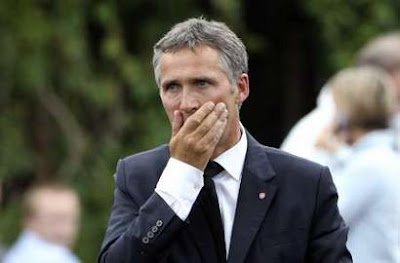
However, what made me feel ashamed to be an Indian most recently had nothing to do with what's happening in India, but what happened in faraway Norway, where nearly 100 people died last week at the hands of a mass killer. Since I don't watch television except while having lunch on Sunday afternoons(I often finish eating while an interminable ad break is still on), I read about the tragedy in the next morning's papers. Most papers had front-paged the picture of a rather good-looking man moving about in a state of daze (one paper showed him embracing another man by way of consolation).
In fact, I happened to notice the picture first, and thought he was a Hollywood actor, the kind who did a lot of World Cinema. Only when I read the headline and the caption did I realise he was the Norwegian prime minister, who was fearlessly out in the open to console the victims of the mindless shooting. The image made my chest swell with pride, even though I have never set foot on Norway nor do I know any Norwegian. And then I sighed to myself as I lit up the first cigarette of the day: "Will we ever have a leader like this?"
Our leaders only pay visits to hospitals long after a tragedy has taken place, and there they solemnly stand by the bed of a victim or two, their hands joined in front of them (perhaps a way of saying that their hands are tied), and return to New Delhi to resume normal life. They don't know the important of body language -- no matter whether they are inaugurating a project or visiting a hospital to condole victims, they always wear the benign grandfatherly expression. Had the Mumbai kind of blasts taken place in the US, Obama would have been on the spot of the blasts, with his arms around the shoulders of the affected and with an expression in his eyes that the perpetrators of the blast would have read as, "Just wait, I am going to fuck you!"
But then, this is India. Here, people have enormous tolerance levels. And such tolerance levels only help in thickening the skins of politicians. There was a time -- oh, that was so long ago -- when railway ministers resigned after a rail accident. It was not as if the minister's negligence would have caused the accident, but there was something called moral responsibility (an extinct term today) and they owned it up.
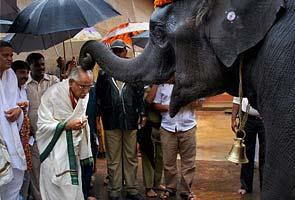
But today we have politicians like B.S. Yeddyurappa, the chief minister of Karnataka, who continues to desperately cling to his chair in spite of being slapped with serious charges of corruption and in spite of being asked by his own party to step down. Any self-respecting politician would have stepped down by now and declared: I will not hold public office again until I come clean. But the desperation of Yeddyurappa to hold on to power is evident from the fact that at least during the last several months, he has done little other than visiting various temples in various states to seek divine intervention in his favour. How much more shameless one can get! So as an Indian, I routinely get treated to pictures such as the one produced below. What a shame!
(Since the pictures above were sourced from the internet, that too in the heat of the moment, I am truly unaware of the identity of the photographers or the agency distributing them. I only hope nobody minds the pictures being reproduced here).
But there are moments when I feel deeply ashamed to be an Indian. Moments that make me wish I lived elsewhere, in a country where prime ministers and chief ministers were not always doddering septuagenarians or octogenarians, where ministers were not always keen on leaving sufficient wealth for their grandchildren's grandchildren to live in comfort, where politicians were sensitive enough to put an arm around the shoulder of a flood victim or embrace the son of a bomb-blast victim, where television channels showed adult films instead of 'breaking news' (you can never be bored by the sameness of watching a pair of breasts as long as they belonged to different women, or if the same woman made an appearance at different times; but to watch the same footage for hours on end and listen to hysterical anchors -- that's torture!).
However, what made me feel ashamed to be an Indian most recently had nothing to do with what's happening in India, but what happened in faraway Norway, where nearly 100 people died last week at the hands of a mass killer. Since I don't watch television except while having lunch on Sunday afternoons(I often finish eating while an interminable ad break is still on), I read about the tragedy in the next morning's papers. Most papers had front-paged the picture of a rather good-looking man moving about in a state of daze (one paper showed him embracing another man by way of consolation).
In fact, I happened to notice the picture first, and thought he was a Hollywood actor, the kind who did a lot of World Cinema. Only when I read the headline and the caption did I realise he was the Norwegian prime minister, who was fearlessly out in the open to console the victims of the mindless shooting. The image made my chest swell with pride, even though I have never set foot on Norway nor do I know any Norwegian. And then I sighed to myself as I lit up the first cigarette of the day: "Will we ever have a leader like this?"

Our leaders only pay visits to hospitals long after a tragedy has taken place, and there they solemnly stand by the bed of a victim or two, their hands joined in front of them (perhaps a way of saying that their hands are tied), and return to New Delhi to resume normal life. They don't know the important of body language -- no matter whether they are inaugurating a project or visiting a hospital to condole victims, they always wear the benign grandfatherly expression. Had the Mumbai kind of blasts taken place in the US, Obama would have been on the spot of the blasts, with his arms around the shoulders of the affected and with an expression in his eyes that the perpetrators of the blast would have read as, "Just wait, I am going to fuck you!"
But then, this is India. Here, people have enormous tolerance levels. And such tolerance levels only help in thickening the skins of politicians. There was a time -- oh, that was so long ago -- when railway ministers resigned after a rail accident. It was not as if the minister's negligence would have caused the accident, but there was something called moral responsibility (an extinct term today) and they owned it up.
But today we have politicians like B.S. Yeddyurappa, the chief minister of Karnataka, who continues to desperately cling to his chair in spite of being slapped with serious charges of corruption and in spite of being asked by his own party to step down. Any self-respecting politician would have stepped down by now and declared: I will not hold public office again until I come clean. But the desperation of Yeddyurappa to hold on to power is evident from the fact that at least during the last several months, he has done little other than visiting various temples in various states to seek divine intervention in his favour. How much more shameless one can get! So as an Indian, I routinely get treated to pictures such as the one produced below. What a shame!

(Since the pictures above were sourced from the internet, that too in the heat of the moment, I am truly unaware of the identity of the photographers or the agency distributing them. I only hope nobody minds the pictures being reproduced here).
Monday, July 25, 2011
Waiting For My Katrina
If you put Sideways, Hangover I, Rock On!! and Dil Chahta Hai in a mixer and blend them nicely, what you get is Zindagi Na Milegi Dobara.
But that's only one way, a hopeless way, of looking at it. Zindagi Na Milegi Dobara, which I watched just an hour ago, comes like a splash of cold water on your face after you've walked a mile in the sun. Not an ounce of flab: each scene well thought-out and delectable.
My favourite scene was the one in which Hrithik Roshan and Katrina Kaif are lying next to each under a star-lit sky, and while giving him some gyaan on life, she holds his hand and in a casual, rather absent-minded, manner places it on her stomach. It can't get more sensual and real-life. Another favourite scene was Naseeruddin Shah rolling up his cigarette and exhaling rich (and most likely aromatic) smoke. He looked every bit an artist, which he is anyway in real life. I felt like lighting up right away.
Though I wish the movie had ended with the frozen shot of the three men running while the bulls chased them: the final song during the rolling of the credits, even though feel-good, was superfluous. But if the audience was enjoying it, why not!
The movie has a message; it's the same message that the commercials of Mountain Dew, the soft drink, have been trying to drive home for a few years now: Dar ke aagey jeet hai -- Once you conquer fear, you are in the arms of victory.
Mountain Dew, in fact, is one of the sponsors of the film and Hrithik, in one scene, is shown holding a bottle of the drink while Farhan Akhtar, in another scene, mouths the same catchline -- Dar ke aagey jeet hai!
But you can't really trust a soft drink manufacturer when it eggs you on to conquer fear, can you? Their intention, after all, is to sell their product. But when the stars of a movie as grand as this set out to prove the same point, you are bound to sit up and think. I won't be surprised at all if the Spanish Embassy in New Delhi is already flooded with visa applications (the film was shot in Spain). And I can bet on my life that a number of people, who are otherwise busy making money and chasing targets, must have signed up for skydiving as well as deep-sea diving after seeing the film.
Fear, after all, is the biggest enemy of the human being. I can give you my own example. Even though I learned how to float in water (while holding the breath) some five years ago, I learned how to swim, in the real sense, only a couple of months ago. Today I can gracefully swim the breaststroke like any professional swimmer, thanks to the hours of daily practice and watching videos on You Tube for tips on improving one's strokes, but I am yet to muster the courage to go to the deep end of the pool. I have gone up to seven feet but not beyond that: 9.5 feet is far too scary! What if I drown?
"No problem sir, if you drown I am there to save you," the lifeguard assures me every evening, "but please go to the deep end." When I refuse, he sulks and refuses to make eye contact for the rest of the evening. He has every right to sulk: he can see that I am now capable of swimming in the deep end with ease, but how the fuck do I make him see the fear that grips me every time I set out towards the deep end? Each time I come up for air, a question gets sucked into my mouth:
What if I drown? What if the lifeguard does not notice me while I am sinking? Even if he dives into the pool, will he be able to save me? Won't I make a spectacle of myself? What will happen to my father if I die? Poor man, he just lost his wife! What will happen to the unwritten books I have in my head? Is it really worth going to the deep end when I can get my exercise even in the relatively shallow part of the pool?
If I were a 10-year-old child, I would not analyse so much: I would merely follow the orders of the coach and dive into the deep end with my nose shut. But as you grow older, you tend to become a slave of fear. Fears, irrespective of their nature, begin to guide your life.
But after watching Zindagi Na Milegi Dobara, I have new-found hope. Hrithik, in the film, happens to be a non-swimmer who is naturally scared of deep-sea diving. But Katrina Kaif, the instructor, sucks the fear out of him and puts in tears of gratification into his eyes once they have done a round of the underwater world.
I am now waiting for a Katrina Kaif to help me proceed from seven feet to 9.5 feet. She doesn't have to be model-like as Katrina (I hate the model-types in any case) but someone intelligent and inspiring enough to make me overcome the fear of depth and cross over to victory.
Saturday, July 23, 2011
Life In A Metro: Bus-Stop Blues
A FEW MINUTES at a bus stop can be a revelation about life in a metro
At least once a day, to give my eyes a break from staring at the computer screen, I step out of the office and stand outside its boundary wall, on the pavement, which also happens to be a bus stop. I lean against the wall and watch the world go past.
Right across the road stands the new Secretariat building, Karunanidhi's dream, its side view resembling a row of mammoth water tanks (oil tanks, if you like), which was abandoned by the new government even before it could be fully completed. My eyes have long become blind to the structure. Most of the time, they are focused on the people at the bus-stop. I watch them and try to imagine their lives – a pastime, rather a luxury, I couldn't have afforded had I myself been waiting for a bus.
Had I been waiting for a bus, I would be constantly watching the display board at the crown of every oncoming bus, and would have been part of the small and ever-replenishing crowd that you always find at a busy bus stop.
The people I see here are collectively known as the ‘common man' – who forms the vast majority of the population in any city and who is powerful enough to make and break governments. But individually, they are powerless and helpless, and their lives are governed by a number of factors, including the timely arrival of the bus. The bus stop is as important a theatre of their life as their home or workplace.
Last afternoon, I noticed a man lying face down on the pavement, lifeless, as if he had just been shot. There was no warm blood trickling out of his body, but there was something else trickling out of his clothes – it was obvious that his urinary bladder had given way soon after he passed out. But why did he pass out? Was he too drunk? Or could it be that he has had no money to eat and been surviving only on water for a couple of days? Or had he suffered a heart attack or stroke? No one knew or even bothered to find out – all I could see were people steering clear of the trickle which was soon collecting into a puddle.
I am ashamed to say that I was among the people who remained totally indifferent to the unconscious man. Such indifference, I think, stems from two reasons. One, it is quite common to see men, presumably drunk, passing out at bus stops; two, who has the time to play Good Samaritan? Each person is in a hurry to reach somewhere. That frightens the hypochondriac in me, though: what if I ever faint at a bus stop? Will I be left to lie on the pavement?
Unmindful of this man lying face-down, a bunch of uniformed children, talking to each other in sign language, played with marbles at the bus stop. Their teachers stood in a small circle and laughed and gossiped while waiting for the bus. The children looked extremely happy in each other's company – did they get to play with the ‘normal' children in their respective neighbourhoods? A little away from them sat an elderly man, wearing a sky-blue shirt and a dhoti. He looked forlorn, lost deep in thought. What was he thinking about: the loan that he had taken for his daughter's wedding? His wife's ailment, which was fast depleting his savings? About a dozen other people, of various ages and bearing varying degrees of frowns, waited too. Why do people in bus stops look unhappy? No, there was a young woman who was constantly smiling – the source of her smile was plugged to her ear. Boyfriend, perhaps?
A bus arrived. The uniformed children, minded by their teachers, got in. The elderly man got in too, as did some of the people who had run behind the bus as it approached the stop. An elderly woman, who couldn't run as fast, was still a few steps away from the door when the bus took off. She was carrying a toy in her hand – grandchild's birthday? She had missed the bus. She now joined the young woman who was still smiling. Meanwhile, the man who lay on the pavement remained lifeless.
Now multiply this scene at the bus stop with the number of stops the city has. What you will see is the real life in a metro.
Published in The Hindu MetroPlus on July 23, 2011.
Sunday, July 17, 2011
Simpler Times
July. August. Up north, where I emotionally belong to, these are the monsoon months. The month of Shraavana. In Hindi, saawan ka mahinaa.
This is the time of the year when the Ganga is usually swollen and its waters muddy. This is the time when the Ganga, which otherwise flows serenely and nourishes the millions settled on its plains, can assume a devastating form.
The evidence of the two different moods of the Ganga lies in the yoga-cum-puja room of my Chennai home. Two white translucent cans are sitting there, both containing water from the Ganga. One of them has water that I had collected during a boat ride in Banaras in November 2007, when I had gone there to collect material for Chai, Chai. The water in it is still crystal clear.
The other contains water I had collected, also during a boat ride in Banaras, in August 2009, when I was there to cremate my mother. A thick layer of sediment can be seen at the bottom of this can. How can I ever forget 29 August 2009: I stood there under an overcast sky, in the furnace-like heat generated by the over a dozen burning pyres, watching the Ganga -- swollen but sluggish.
Monsoon seems to have hit the Ganga Mail too. The more swollen the mind with thoughts, the muddier the thought process, and you can't see what exactly is there at the bottom of the mind that needs to be expressed.
The less the number of thoughts, the simpler and more effective the thought process. People living in the hills are simple people, and they lead a simple life. That's where the Ganga gurgles down with great force, and the water so cold and clear that you can often see what's at the bottom. It flows like a good piece of writing.
It's time to pay a visit to the hills; to return to simpler times.
Saturday, July 16, 2011
Life In A Metro: Cool Writer
The business of writing has changed – everyone wants to become a published author
The other day, a childhood friend of mine, who is now a senior uniformed officer, called me up. He began by making polite enquiries and went on to ask my opinion about the future of the DMK. Since he called at 10 in the morning, when catching up with old friends would be the last thing on the mind of an office-goer, I knew he would soon come to the point. Sure enough he did.
“By the way, do you have Ruskin Bond’s phone number?”
“Whose?” I couldn’t believe what I had just heard.
“Arre yaar, apna Ruskin Bond! The writer!”
“But I don’t have his number!”
“Why not? You are also a writer, na? Don’t writers have other writers’ numbers?”
(In late 2009 I wrote a travel book; therefore the ‘writer’ tag.)
“But why do you want his number?” I asked him.
It turned out that his boss’ teenaged daughter had written some short stories, and the boss was keen that Ruskin Bond should take a look at them. When the boss brought up the subject during a meeting, my friend volunteered to get Mr. Bond’s number from a friend – that’s me. He obviously wanted to please his boss – nothing wrong with that – but he had clearly overestimated my status as a ‘writer.’
It is one thing to have written a solitary book – as countless people have – quite another to have earned a reputation as a writer.
After he hung up – I promised him I would try my best – it suddenly struck me that this was perhaps the fifth or sixth call I had got in a span of two months on behalf of aspiring writers. And in all cases, the aspiring writer in question happened to be a teenaged girl, and the caller a highly concerned parent.
One worried mother, who had been turned down by established publishing houses, confessed to me that the number of stories written by her daughter was not adequate enough to add up to the size of a book. But she had a solution for the shortcoming. “I can put in some of the poems she has written. She has written some beautiful poems. If we still fall short, I can put in some of my paintings. I have done some beautiful paintings,” she told me. “But how do I find a publisher?”
Had I known the answer, I would have been a rich man today, sitting with my laptop in a villa in Goa or Kasauli, after having sold half-a-dozen ideas (most of which would’ve come to me while I was shaving) to a publisher for a huge advance. But the business of getting published remains mysterious – no one quite knows what works for the publisher and what doesn’t.
Jack Kerouac’s On The Road failed to find a publisher for six years before it changed the way people wrote. James Joyce's Dubliners got rejected 22 times before it got published. The first two novels written by Graham Greene got rejected by each publisher he sent them to, and it was his third novel that officially became his first book. And without Greene’s helping hand, what would have happened to our own R.K. Narayan, despite all the lucid prose and eye for detail?
But publishing is one field that has never concerned the lay Indian, who is usually too bogged down by other demands of life to spare money for books. Even today not many would have heard of R.K. Narayan, leave alone Raja Rao and Mulk Raj Anand – they formed the triumvirate that pioneered Indian Writing in English. Writers like them lived in a small island, hoping to be connected to the mainland.
Shobhaa De changed the game. She not only got people interested in her books but also in the business of writing books: “If she can, why can’t we?” Subsequently, Arundhati Roy enlightened India about the existence of the Booker Prize (and the prize money it entailed). But it was Chetan Bhagat who brought about a revolution – he brought down writing from the pedestal of exclusivity and took it to the masses, and in the process stoked a million literary ambitions.
Today, the writer is no longer a faceless entity. The successful ones now get the attention that once only movie stars and cricketers did. It is, therefore, not surprising that parents are suddenly spotting the ‘writer’ in their children and frantically knocking at the doors of publishers. Ruskin Bond, alas, did not have that luxury: he had to struggle to find a publisher. That reminds me, does anyone have his number?
Published in The Hindu MetroPlus, July 16, 2011.
Friday, July 15, 2011
Time Flies, After All
I am a fairly new entrant to the locker room. I have never been used to the idea of changing in front of strange men -- or rather strange men changing in front of me. But now that's become a part of my life, considering that these days I'm pretty regular at the gym and the pool in the club.
Almost every evening I am subjected to about half a dozen instances of unintentional mooning, and to tell you the truth, when I come face-to-face (or should I say face-to-cheek) with reality, I often can't decide whether to instantly turn my gaze away or to look at the naked posterior of a man as if it was a bald head. Most often, I look away, but the eyes invariably manage to capture a few seconds of the images that the mind would rather not like to store.
And the other day, my eyes saw more than they had bargained for. I noticed a tall, well-built foreigner -- a white man -- standing right next to me as I fished for my swimming trunks in the bag. I had been noticing him in the pool during the recent weeks and even admiring his swimming skills, and now he was standing right next to me, changing into his swimming trunks. I don't wish to describe what the corner of my eye saw, but suffice to say that I was instantly reminded of two expressions -- "hanging loose" and "well-endowed".
All these men happen to be of varying ages and possessing varying degrees of fitness. In most cases, I don't ever want to be them, given their girth; and in some rare cases, I so want to be like them, especially the kinds who swim effortlessly. And then, there have been times when I looked at myself in the mirror, clothed waist-down of course, and thought: "Not too bad. Maybe a little more sculpting?"
One such evening, when I was looking at myself in the mirror, reality slapped me hard on my face. Mr S, a senior member of the club with who I had become friends in the swimming pool, had got himself entangled in his T-shirt.
Mr S, a widower, must be nearing 80 now, if not already 80-plus. He was born in Islamabad, from where he migrated to Ambala after Partition, and subsequently ran a business in Calcutta for a few years before relocating to Madras. "Dada, kamon achhen?" he would ask me routinely, in Bengali, as he took toddler-like steps in the pool, perhaps on the advice of his doctor. That evening, as he was taking his T-shirt off to get into the pool, the muscles of his hands suddenly gave away. He just couldn't pull the T-shirt off his head. By the time I could reach him, a young man had already helped him out of the T-shirt. That was the last time I saw Mr S in the pool (these days he just drags a chair and sits by the pool to watch other people swim).
Today, whenever I look into the mirror, I can see Mr S smiling back at me. I may be physically fit and having a well-sculpted body today, but the future belongs to the likes of Mr S. Tomorrow, in spite of the fitness levels I enjoy today, I might not be able to lift my arm to even wear a shirt. What's the point, then, in trying to remain fit? That too when old age is not too far away -- time flies, after all.
Saturday, July 09, 2011
The Sea
The moon peeped in through the coconuts leaves, as if trying to eavesdrop. The strong breeze from the sea blew her hair across her face. At some distance the waves were breaking, softly enough for me to hear her sighs. She leaned forward across the table and formed an extra curtain of palms around mine to help me light up a cigarette.
"Thanks," I said, as I sat back and took a sip of the beer.
"As I was saying," she continued, "I can't have sex with a man unless I am in love with him."
"Really?"
"Yes, if I love a man, I wouldn't mind sleeping with him."
"But why go through the whole process of falling in love?"
"Without love I can't have sex. And it doesn't take me long to fall in love; it can take just three or four days. I just know when there is an emotional connect."
"Of course there has to be an emotional connect," I said. "But I wouldn't call it love?"
"But you do believe in emotional connect, don't you?"
"I do."
"So there."
"Are you tipsy already?" I asked.
"Just one Bloody Mary, what bloody tipsy!" she laughed.
"So how is it going with Atul?"
"Hey come on! Just because I was talking about him does not mean I am in love with him or going to sleep with him. Come on, I know him since the time we were kids. We grew up together!"
"Oh really?"
"Yeah, I like him and all, but not in that sense."
"I see!"
"And you know, he drinks only beer. And I don't like men who drink only beer."
I looked at my glass and suddenly felt like a man who had been caught with his fly open. She read my thoughts instantly.
"I know you are drinking beer now, but I also know that you have other drinks too, don't you?"
"Yes, I usually drink whisky."
"See! I knew."
"But how?"
"I read you."
"Oh! But what is your problem with men drinking only beer?"
"When a man drinks only beer, it means he is playing it safe and is not open to adventure. Such men are not my kind."
"I like that!" I said. I flicked the ash of the cigarette, even though there was no ash to be flicked, and turned my gaze to the sea, which was now so black that it had merged with the blackness of the sky.
I found it safer to gaze at the nothingness than looking into her eyes.
Life In A Metro: Resting In Peace
Uninterrupted sleep is no longer a necessity - it’s a luxury
Let me make a small guess: two out of every five people reading this column are doing so half-heartedly. They have something else nagging them, apart from the weekly whining by yours truly. Their mind is seized by a thought, rather an unfulfilled desire: Wish I had slept a little more!
You may have an Audi parked in your garage, you may be travelling business class in planes, you may have the biggest flat-screen mounted on your wall, you may be sipping single malt or vintage wine every evening from the stock that keeps getting replenished by your regular stopovers at duty-free shops, you may even have an air-conditioner installed in your bathroom. But you cannot purchase what has turned out to be the biggest luxury of our times – a sound sleep. You may try stealing it though.
Ironically, the better your position to buy the regular luxuries of life, the more elusive this luxury tends to get. And considering that almost everybody these days wants to be in a position to buy a flat or bring home a plasma TV or send their children to the best of schools, irrespective of their incomes, people are working harder than ever before. Good life, after all, comes at a price, and these days, the price seems to be uninterrupted sleep. But is life any good if you haven’t even slept well?
We have, however, made peace with interrupted sleep. Anybody can wake us up at anytime: it could be the hysterical boss who is prone to waking up at five in the morning; it could be a panicky colleague urgently in need of your guidance at midnight; it could be a man from the bank reminding you about the minimum payment due on your credit card; it could be a woman from the same bank offering you a loan to clear the outstanding dues on the credit card; it could be the call-taxi driver reminding you that he is waiting outside your flat to take you to the airport (while you are still in bed); or it could just be the alarm programmed in your mobile phone reminding you that it’s time to wake up your child because the school bus will be coming soon.
When I was a child, which was not too long ago, a sound sleep was taken for granted. The three biggest enemies of sleep – satellite television, mobile phone and laptop – were yet to invade our bedrooms. There was Doordarshan, but it would end transmission by nine – or was it 10 pm? The announcers on All India Radio too took leave by 11 pm. After that, you had no choice but to sleep.
And it was very easy for one to fall asleep those days. Most people bicycled to work; and they thought nothing of walking a kilometre or two every evening to the nearest market to fetch vegetables and groceries. The road was their gym. Real gyms didn’t exist anyway.
Today we either order groceries over the phone or stock up for the entire week during a Sunday visit to the supermarket. We no longer know what it means to walk. There may be gyms now in every neighbourhood where you can walk on the treadmill, but does it mean you get to sleep like a log at the end of the day? No. You usually doze off either while surfing the net or answering a text message or watching ‘breaking news’ on TV – only to be woken up soon after by a phone call. Even before you realise, it is another day.
The Internet is replete with stories about the death of the immensely fit Ranjan Das who, at the young age of 40, was appointed by SAP, a multinational software provider, to head its operations in the Indian subcontinent. Within two years, in 2009, Das dropped dead after a workout in the gym, and the cause of his death has been pinned down to lack of sleep. He slept for less than five hours, as he had admitted during a television interview – even though doctors these days prescribe seven hours of good sleep, especially for those who have touched forty.
If you sleep less than five hours, the chances – so I learn from the Internet – of high blood pressure increases by 350-500% and heart attack by threefold. You can’t really dispute such claims when you are used to waking up in the mornings feeling unwell and craving more sleep.
This column, in fact, is inspired by a Facebook page called Ghum, which was started recently in Bangladesh, most likely by a sleep-starved soul. Ghum, or ghoom, in Bengali, means sleep; and as many as 134,327 people ‘like’ the page as of date. Compared to that, only 6,976 people ‘like’ Franz Kafka so far; while only 6,545 people have bothered to click on their mouses to ‘like’ George Clooney. Sleep, clearly, wins hands down. Really, when was the last time you slept like a log?
Published in The Hindu MetroPlus, July 9, 2011.
Saturday, July 02, 2011
Life In A Metro: The Might Of The Majority
Majority opinion is everything — it can even change your surname
When I started my career in journalism nearly two decades ago – “20 years” would have made me sound just as ancient – as a trainee sub-editor with The Pioneer in Kanpur, one of the errors I looked out for in a copy was the merging of “per cent.” Most reporters spelt it as one word, and I would dutifully draw a line between “per” and “cent” to indicate to the compositor that there should be a space between the two. Those were the days of the horse-shoe desk, when the news editor or the chief sub-editor sat at its centre and distributed typed or hand-written copies for editing to his juniors who sat in front of him, pens ready.
Within a year and a half, I moved to Delhi to join the Press Trust of India. There too, it was “per cent” and not “percent.” But in the impeccably edited copies spat out by the ticker machine of Reuters, with which PTI had a news-sharing arrangement, it was already “percent.” This was in the mid-1990s. Today, even spell-check does not underline the word in red.
But is it really correct to say “percent” instead of “per cent?” No. But the majority, be it in Parliament or in society, always has its say – and way – and the custodians of the language had to allow it as an acceptable word.
It is only a matter of time before “inspite” and “accomodate” become acceptable too: the number of people who are either ignorant or don't bother to insert the space and the extra “m” respectively in the two words is getting too large to ignore. Many American magazines today use "Prez" instead of "President" – something that might have been considered irreverent even a couple of decades ago. A classic case of the corruption of a word gaining public acceptance is “juggernaut.” The original word is Jagannath, another name for Lord Krishna in Puri, who is taken out in a chariot in a massive procession each year. Somewhere down the centuries, Jagannath happened to enter the English dictionary as “juggernaut,” defined as “any large, overpowering, destructive force or object” (the definition, obviously, is inspired by the chariot procession).
Talking of present times, the expressions that we use during online chats, such as LOL (laughing out loud) and OMG (oh my god) were incorporated by the Oxford English Dictionary in its updates this year. WTF – I don't wish to expand it here – was already included in 2009 (or so I am told). So go ahead, coin your own abbreviation. How about IABM – In A Bad Mood? If it gets picked up by the public, chances are that your creation will enter the OED.
Once a misspelled word gains currency, it no longer matters how it came to be misspelled in the first place – it could have been ignorance, indifference, laziness or a stupid clerical error.
As far as clerical errors go, who should know better than Mr Henry Sullivan Graeme and Mr Richard Yeldham.
These two gentlemen lived around the same time in East India Company-ruled Madras. Graeme, a civil servant, was a member of the Madras council for five years from 1823. He owned a bungalow in Nungambakkam, and the road connecting his bungalow to Mount Road was subsequently named Graeme's Road. Yeldham, on the other hand, was a merchant of the Company who went on to become the mayor of Madras. The road from his palatial house in Teynampet to Mount Road came to be called Yeldham's Road.
Today, Graeme's Road has been rechristened Greams Road, and Yeldham's Road is Eldams Road. Who is responsible for the changes in their names? No one knows. But today, even if Mr Graeme and Mr Yeldham were to come out of their graves and plead with Chennai Corporation to restore the correct spellings of their surnames, they are most likely to be turned away. Mr Graeme would return to his grave as Mr Gream and Mr Yeldham as Mr Eldam. Such is the power of popular usage.
Published in The Hindu MetroPlus, July 2, 2011.
Monday, June 27, 2011
While It's Still His Birthday...
Here's presenting a gem composed by R.D. Burman who, if alive, would have been 72 today. Though not necessarily as popular. There is something magical about death: it makes the world realise the true worth of an artist. But when alive, the same artist has to prove his worth with every single composition or song or book in order to stay alive professionally. Or else the 'world', which can be very mean and ungrateful, tends to forget you -- until you die. Look what happened to Michael Jackson.
This song, Hum tum ghum sum raat milan ki, is close to my heart for two reasons. One, it happens to be one of the three songs that got ingrained in my mind when I was still a baby -- too young to even know what a song is. (The other two songs being Kanchi re kanchi re and Panna ki tamanna: both Pancham!). Reason no. 2: this song belongs to the great body of rarely-heard songs that Pancham created during his lifetime. This great body of work, containing songs that are as perfect as a Hindi song can get, was discovered and toasted only after he died. Chancing upon such songs is like finding an unopened whiskey bottle in the cabinet of your long-dead grandfather. This song is one of them -- I am so glad that I did not stumble upon it recently but had the tune buzzing in my head since childhood: Jhumnaa jhumnaa, jhumnaa jhumnaa.
It's a sensual song, and just look at the way Kishore Kumar has modulated his voice! He is neither humming, nor is full-throated -- he is somewhere in between, to suit the mood of the evening. Asha Bhosle, of course, matches up to him effortlessly. Sip the song and enjoy -- and while you do so, do remember me!
Subscribe to:
Posts (Atom)